• Skip to primary navigation
  • Skip to main content
  • Skip to primary sidebar
dune-doctors-logo
Search
Let’s Talk 866-386-3737
  • Get Started
    • Dune Diagnostic Form
  • Our Expertise
  • Our Services
  • About
    • Our Team
    • Our Clients and Coastal Partners
    • 25 Years History Timeline
  • Resources
    • Prescription for Protection
    • Articles
    • Videos
    • Regulatory Agencies
    • Science and Reports
  • Contact
  • Prescription for Protection
  • Get Started
    • Dune Diagnostic Form
  • Our Expertise
  • Our Services
  • About
    • Our Team
    • Our Clients and Coastal Partners
    • History Timeline
  • Resources
    • Prescription for Protection
    • Articles
    • Videos
    • Regulatory Agencies
    • Science and Reports
  • Contact
  • Prescription for Protection
  • Let’s Talk 866-386-3737
  • Our Expertise
  • Our Services
  • About
    • Our Clients and Coastal Partners
    • Our Team
    • Contact Us
  • Resources
    • Videos
    • Science and Reports
    • Articles
    • Prescription for Protection
  • ASBPA

Frederique Beroset MBA & M.S. in Biology

Dune Irrigation: Avoid this Costly Mistake

June 7, 2026 by Frederique Beroset MBA & M.S. in Biology

Irrigation Systems Harm Sand Dunes

It seems counter-intuitive, but watering the vegetation on your sand dunes is actually detrimental to the health and strength of the dune system. How is this possible? The availability of moisture close to the surface of the sand will dissuade the native plants from growing deep roots in search of water. Irrigation also encourages invasive species to propagate over the sand dune. We frequently discuss how planting appropriate vegetation on your sand dunes is necessary to anchor the dune in place. Most plants that grow along the coast (both naturally-occurring and those that were installed) have adapted to thrive in tough environmental conditions. They are very hardy, but they do require some unique maintenance such as dethatching (removal of dead plant material). However, unlike lawns and gardens, dune vegetation does not need regular watering. In fact, installing an irrigation system on your dunes will compromise the dune’s resiliency. Initially, the plants may appear lush and vibrant; but, over time, routine irrigation will kill the native vegetation, increasing the rate at which your sand dunes erode.

Deep Root Systems Build Powerful Dunes

Plants that grow along the coast are resilient by nature. They thrive in an ecosystem characterized by harsh winds, periodic driving rain, and scorching sun.  Not only do they enhance the sand dunes aesthetically, but they also fulfill a vital role in defending your property from coastal erosion. If you were to dissect a sand dune with healthy vegetation, you would find that the plants have laid down impressive web-like root systems to reach moisture located deep within the sand. Without regular irrigation, the plants’ roots will grow upwards of 30ft in search of deep water. These roots weave through the sand, creating a natural web that anchors the dune in place and stops wave action from eroding sand.  However, with the provision of a regular source of water at the surface, the plants lose the incentive to put down deep, vertical roots in favor of concentrating their root growth along the surface. This shallow root system creates a cascade effect where the sand dunes (no longer anchored by deep, complex root systems) suffer tremendous sand loss at the slightest storm.

Excess Moisture Causes Root Rot 

With easy access to water, your vegetation will redirect its focus and energies from root growth to stem and leaf production. This may not seem like an issue, but to understand why it is detrimental to the plants’ health, you must first understand the continuous cycle coastal plants undergo of being buried in the sand. In this cycle, wind-borne sand repeatedly covers the base of the plants. This burial cycle is critical to the plants’ survival. As the sand builds up, it causes the plants to undergo growth spurts in reach of sunlight and airflow. This cycle also buries dead organic material, allowing it to decompose under the sand into usable nutrients for the plants. But, if the plants produce leaves at a faster rate than the sand can bury the additional growth, the excess leaves will remain above ground and trap moisture. The damp organic material will, in turn, rot and potentially attract diseases that can weaken and/or kill the plants. 

Irrigation Attracts Invasive Species  

As detrimental as extra watering may be to plants that are native to an environment frequently subjected to droughts, this is not the case for invasive species. Invasive non-native plants will find the moisture-rich sand a favorable environment in which to grow. These invasive species are a real concern for multiple reasons. With time, these weeds will take over substantial parts of the dune by overshadowing and eventually choking out sea oats and other native plants. This is because, without adequate sunlight, native vegetation eventually dies. These non-native vines are also equipped with bean-like seed pods, which, when ripe, spread their seeds far and wide. These seed pods increase the presence of weeds exponentially over time. The more water these plants receive (i.e., irrigation / regular watering of the dune), the faster and further they grow.

Consequences of Weed-Whacking

 Once the weeds take hold of your coastal dune, the process of extracting them is difficult and requires delicate pulling in order to avoid uprooting the native vegetation. We strongly DISCOURAGE the use of weed whackers or trimming to manage the weeds. The result will be a thick mat of decaying vegetation and a massive broadcast of the seeds. It may seem like an efficient short-term solution, but by next summer, the rapid growth of new vines will choke out the beneficial vegetation and spread to neighboring properties, too.

Have an Irrigation System? Turn It Off!

In order to avoid these nightmare scenarios, we recommend that you avoid watering your dunes altogether. If you are working towards reversing the effects of installing an irrigation system and need help identifying intrusive species, reach out to us. As you develop a greater understanding of how coastal dunes work, you will gain confidence in employing the necessary steps to create a thriving dune ecosystem. Remember, coastal plants are not the same as conventional yard/garden plants. They need care that is specifically tailored to their needs if they are to offer your property any kind of protection in the event of a storm. Aside from saving your dunes, not irrigating will save you money. 
Filed Under: Maintenance

Alys Beach: 14-Year Transformation

March 12, 2026 by Frederique Beroset MBA & M.S. in Biology


14-Year Transformation: Alys Beach

     In 2006, Alys Beach’s dune was bare with no vegetation to hold the sand in place. We initially installed 27,500 plants, and over a decade later, we are returning to revitalize those same plants by implementing Phase 1- Preservation. The area we are dethatching spans 50,000 square feet and is covered in a dense mat of dead vegetation (thatch). Once the thatch is removed, we will hand-broadcast a coastal-specific, custom-blended, slow-release fertilizer designed to help the plants grow deep roots after undergoing the thatch-removal process. Furthermore, we will be carrying out routine maintenance on the property to observe and tend to the plants as they reestablish their complex root systems in search of moisture located deep within the core of the dune. 

Thatch = Dried Out Coastal Plants

      One of the key sources of nutrients for these coastal plants are their own leaves and stems that die and are quickly buried by the wind. However, when wind cannot bury the dead plant material fast enough, a clump that resembles a ball of yarn can form at the base of the plant. This clump of dried out dead plant material is called thatch. A buildup of thatch is detrimental because it can concentrate moisture at the surface of the dune or dry out and pose other threats. 

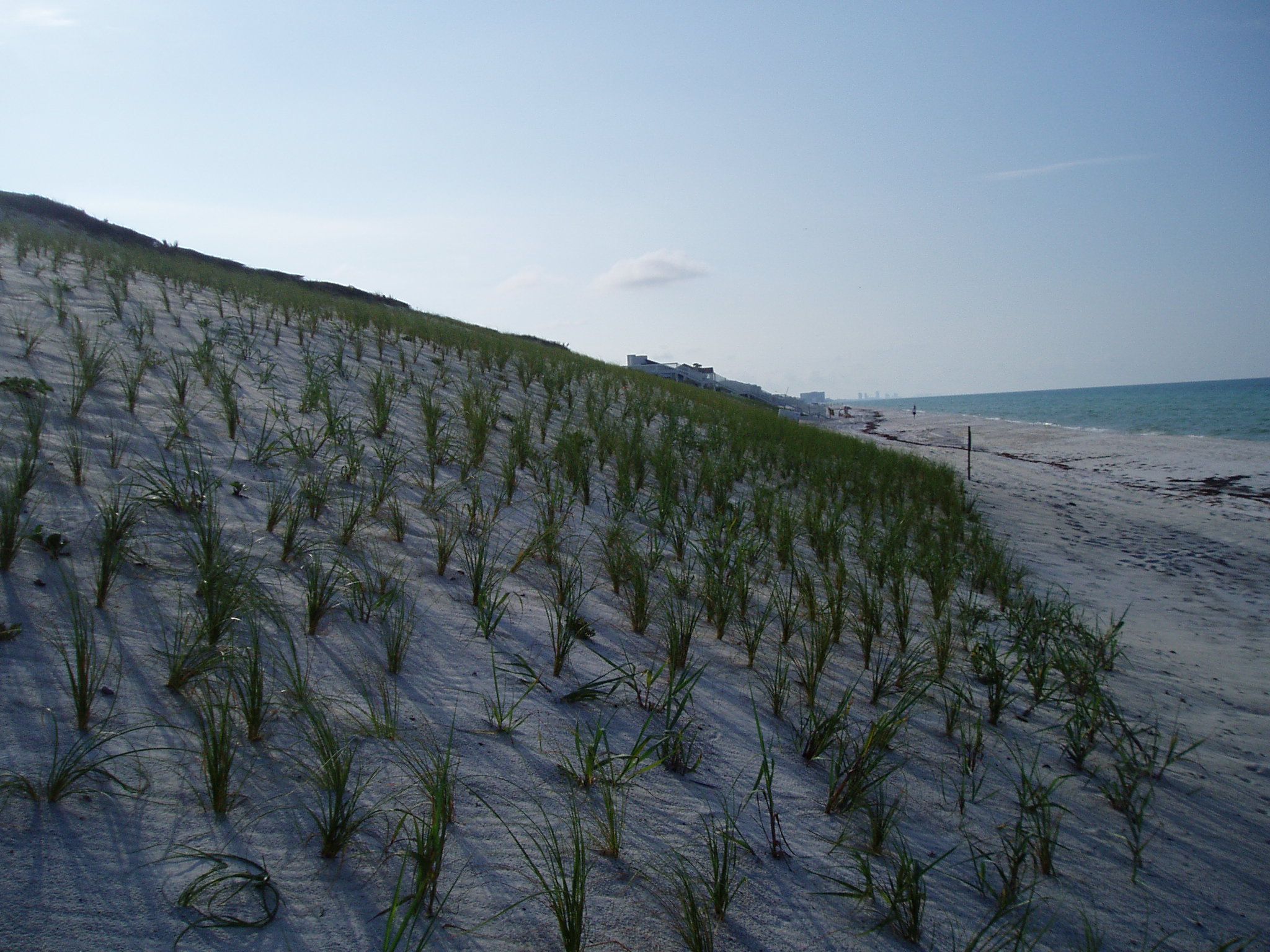
Alys Beach Dunes Bare with no Plants

Alys Beach 04-20-2006

Alys Beach Dunes after first Planting was concluded

Alys Beach 06-02-2006

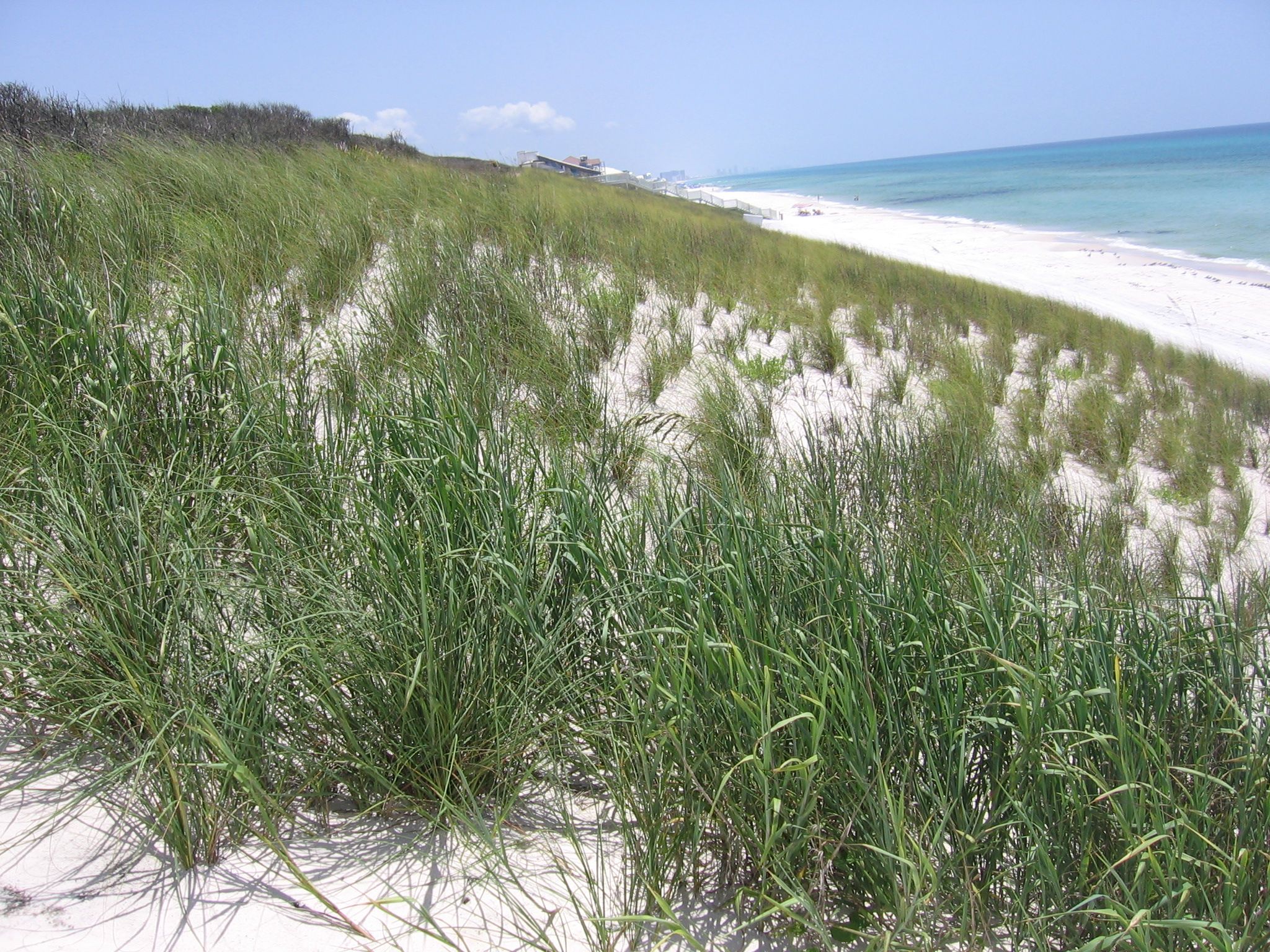
Alys Beach Dunes with Coastal Vegetation Steadily Growing

Alys Beach 07-19-2007

Alys Beach with Coastal Vegetation Expanding Across Dune

Alys Beach 07-08-2008

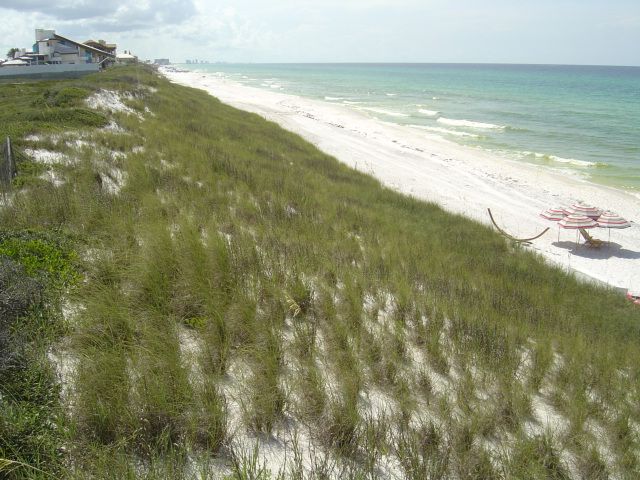
Alys Beach with further established coastal vegetation.

 Alys Beach 08-26-2011

Alys Beach: A Pause in Dune Restoration

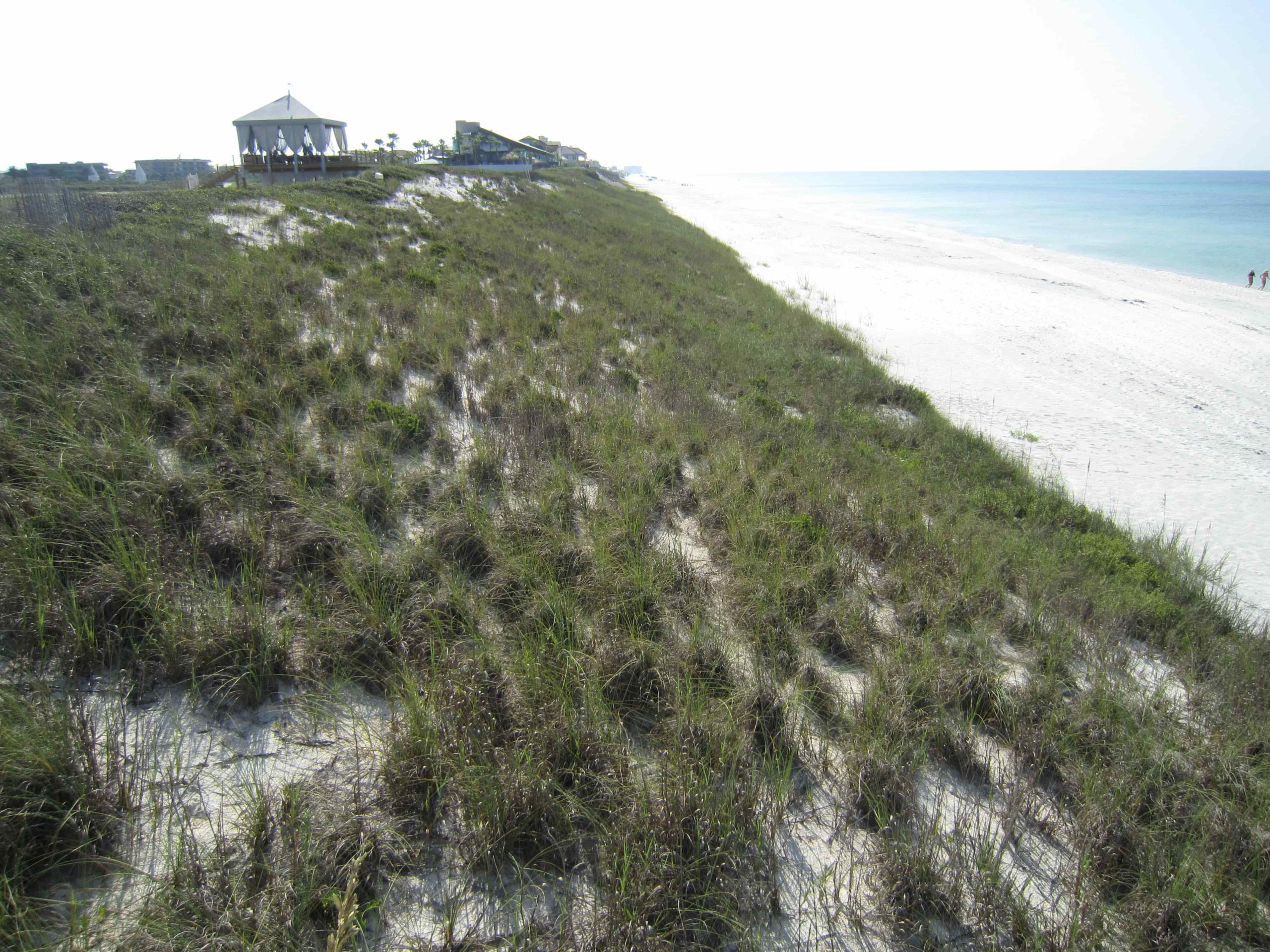
     Over the years, the vegetation we installed on Alys Beach’s dunes fared well. As you can follow in the images above, between 2006 and 2011, the plants matured, established, and progressively colonized the beach, thus accumulating significant amounts of sand at the toe of the dune. However, from 2011 to 2020, due to economic constraints, Alys Beach did not invest in its dune ecosystem, and the plants on the slope suffered from both the inherent lack of nutrients in the quartz sand and from the progressive build-up of thatch. But now, the right steps are being implemented. To restore the dune, after nearly a decade of no care,  we were called to evaluate it and implement a Dune Master Plan™ to restore the dune and optimize the protection it provides.

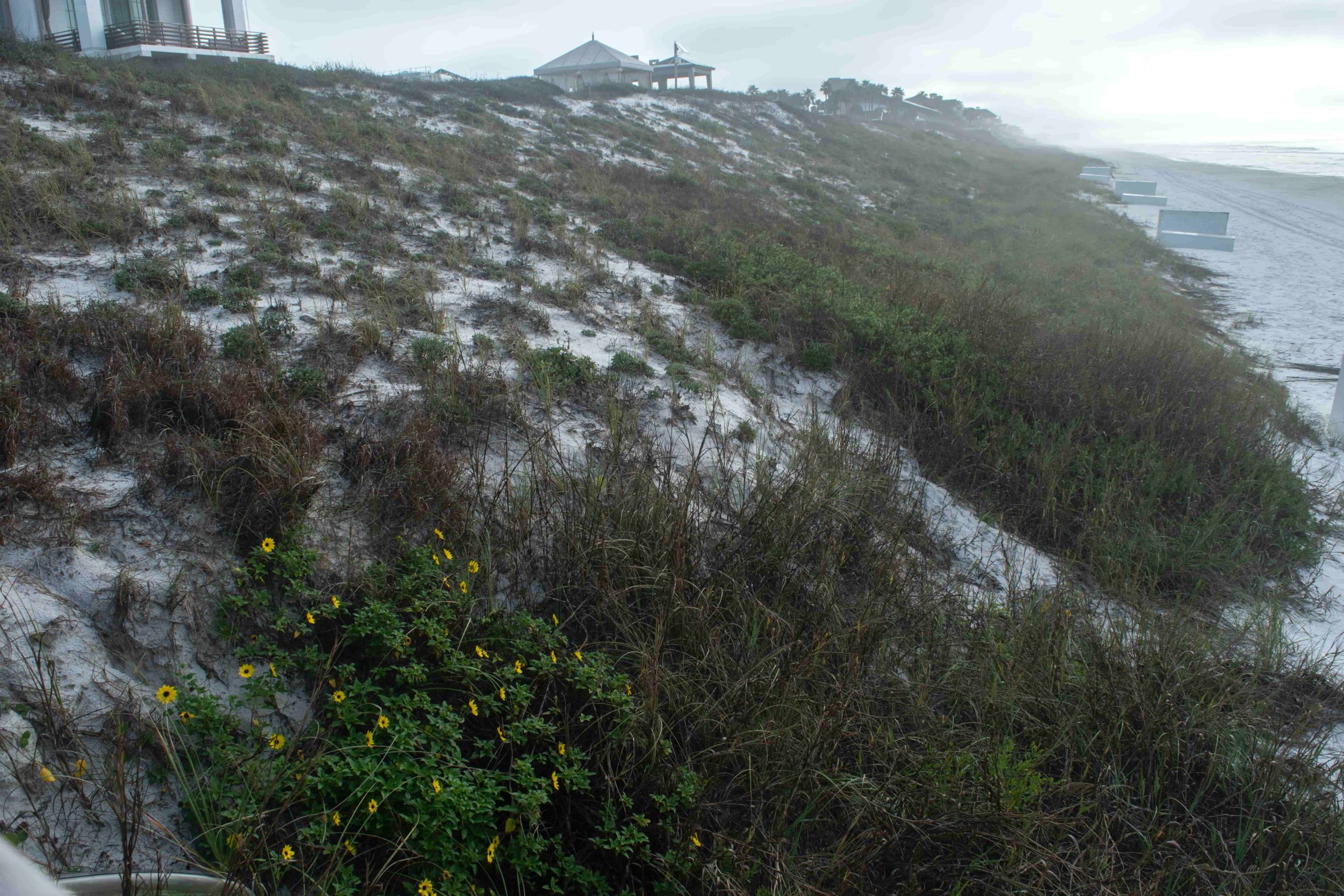
Alys Beach Nearly a Decade Later Covered in Thatch

Alys Beach 02-01-2020

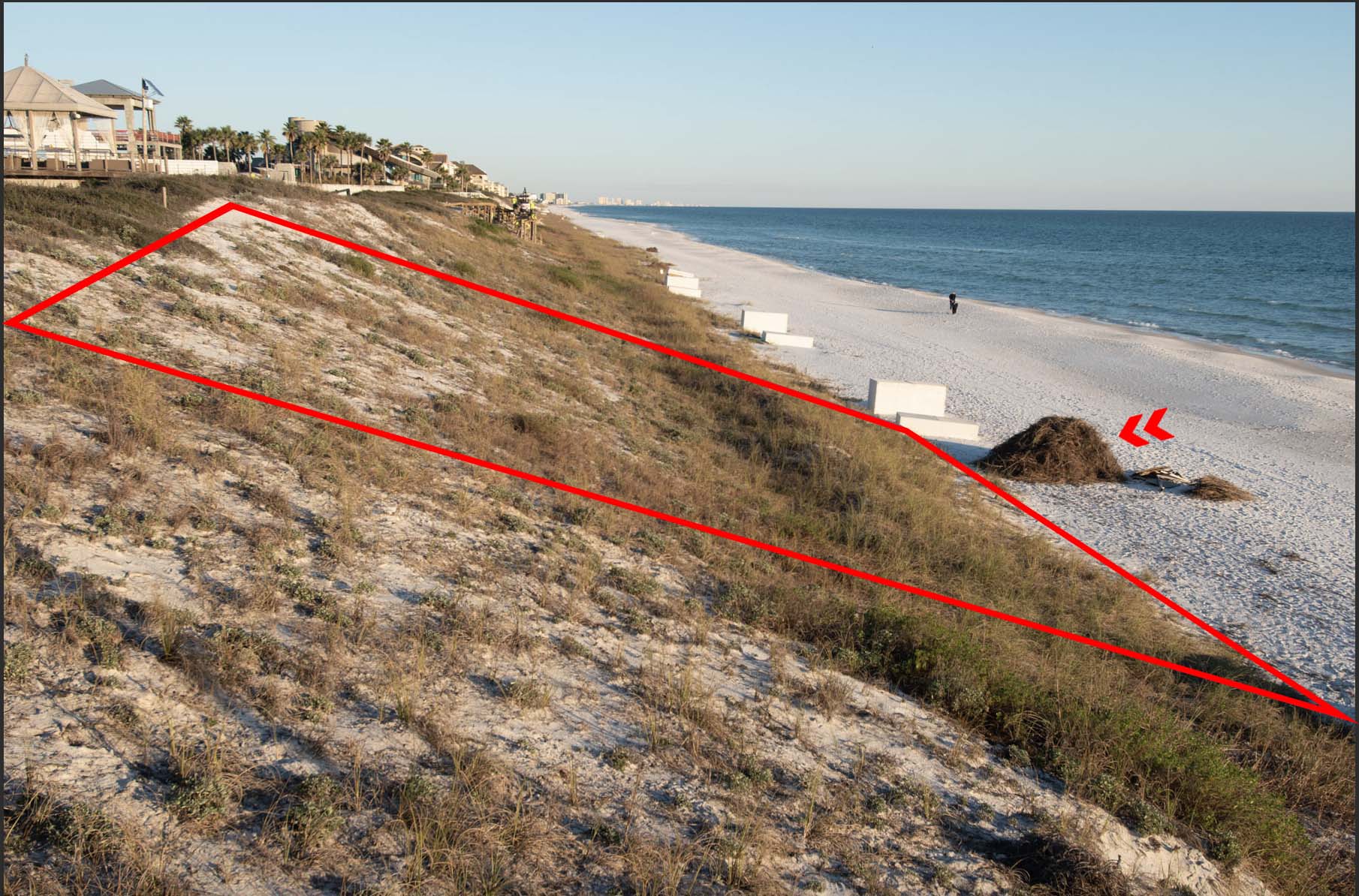
Alys Beach 2020 – Phase  1: Preservation Benefits 

This picture was taken upon Dune Doctors’ return to Alys Beach following almost a decade of no dune maintenance. The grasses were dormant and brown also due to the fact that it was captured during the winter season. The section highlighted in red has been dethatched. The dead plant material extracted from that section sits in a pile at the toe of the dune.

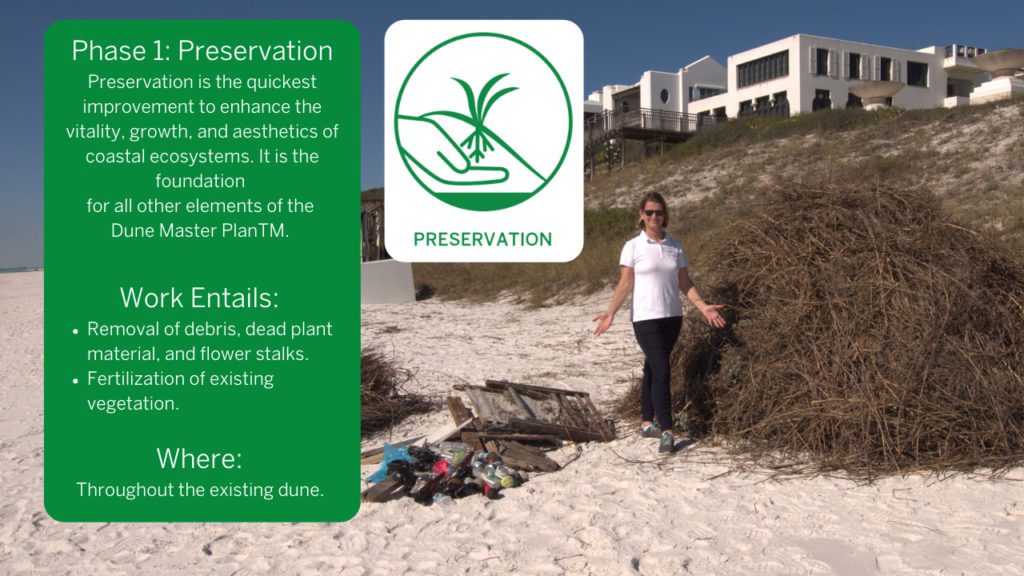
     Phase 1 – Preservation is often the starting point for most sand dune restoration projects we carry out. Phase 1 focuses on removing invasive and dead vegetation.  Other steps are also taken to encourage a healthier ecosystem where the native vegetation develops a root system that is deeper, stronger, and more resilient to surge. This phase is the basis for all other components of the Dune Master Plan™.  The native vegetation already in place is any dune’s greatest asset and needs to be preserved. Coastal plants are designed to survive high winds, droughts, temporary inundation, and being repeatedly buried by wind-borne sand. The vegetation thrives under these dynamic conditions and ,when properly taken care of, responds by sending out a complex root system that weaves a web throughout the dune. This complex root system, in its search for moisture and food, is what transforms a pile of sand into a protective berm that can limit the landward reach of storm surge. 

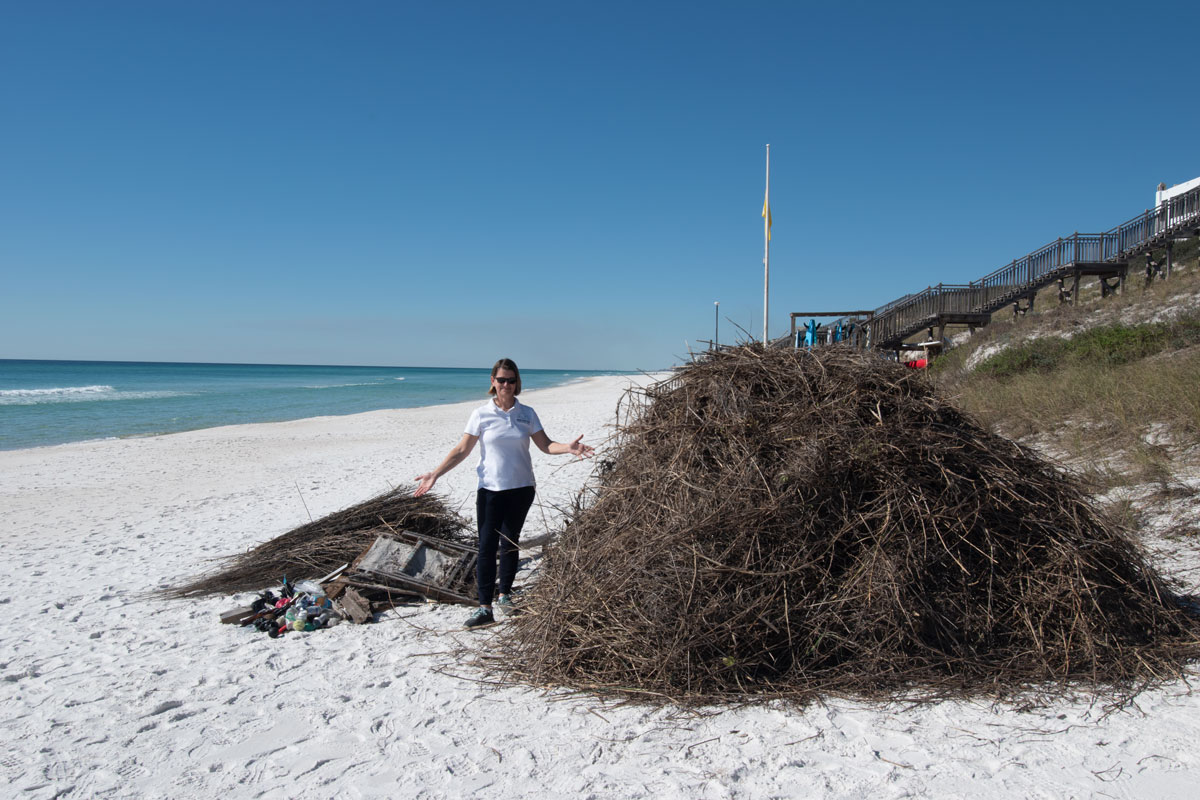
A pile of thatch extracted from a segment of a dune at Alys Beach

Alys Beach 04-08-2020

Risks Posed by Thatch

     If the thatch is exposed to rain or high humidity, it will collect water and offer an ideal breeding environment for diseases that will eventually kill the plant. The surface-level moisture will also cause the plant to not send out deep roots in search of water. On the flip side, if the coast undergoes an extended period of drought, the thatch will dry out and become a fire hazard that can quickly engulf a dune in flames if accidentally ignited by a cigarette butt or fireworks. The thatch also provides safe harbor for invasive pests like snakes seeking out the non-native rodents hiding among the dried out vegetation. Your takeaway should be that an accumulation of thatch will result in weak coastal plants with shallow root systems. These shallow roots are not effective at holding sand in place and by consequence the dune they grow in is less capable of protecting your property against storm surge. 

P3: Optimization – Revegetating the Dune

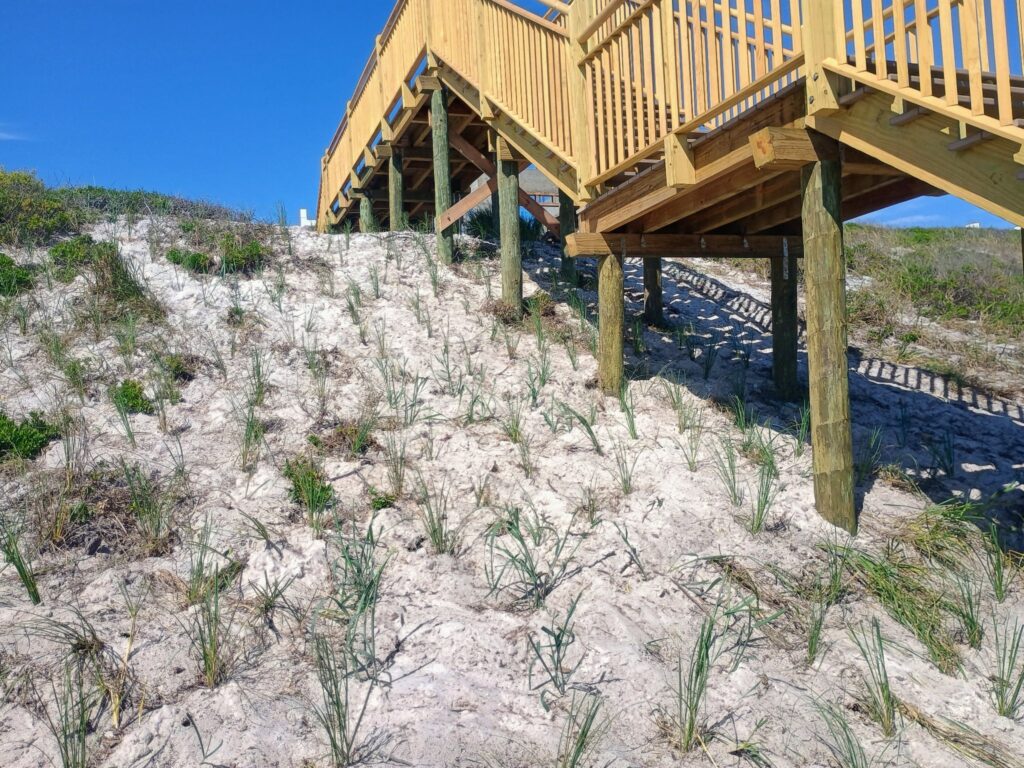
After cleaning the dune by removing debris and dead plant material, our team vegetated the bare areas, as part of Phase 3 Optimization of Alys Beach’s Dune Master Plan™. The goal of this phase is to limit sand departure and stabilize the existing dune by installing diverse native dune plants. As part of Phase 3, native grasses along with ground covers are planted throughout the dune in exposed areas that are susceptible to erosion. The grasses weave complex roots through the dune, strengthening the core of the dune. While ground covers grow along the surface of the dune, stopping the wind from blowing away sand. In total, over 18,000 native plants were installed to enhance the dune system.

As part of Phase 3: Optimization, vegetation was added to exposed areas such as around the boardwalk and along the slope of the dune from 2020 to 2026.

P4: Maintenance, Enriching the Dune Ecosystem

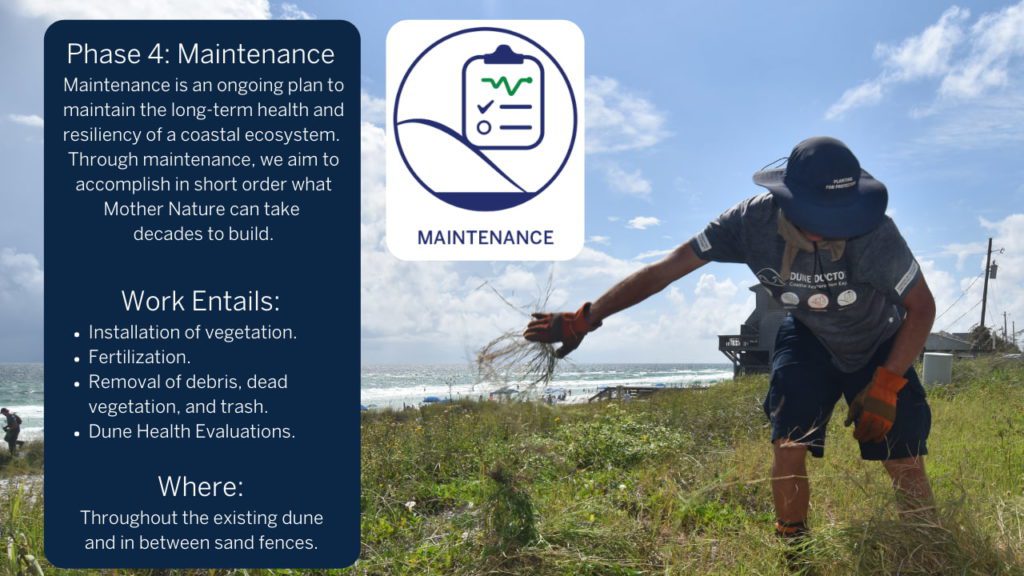
Dune ecosystems are part of the living coastline; however, with coastal development, the natural evolution of the dune system has been impacted. Therefore, along developed coastlines that heavily depend on the dune to protect infrastructure from storm surge, ongoing maintenance is necessary to strengthen vegetation by providing nutrients and removing debris. The maintenance program includes regular monitoring of dune development, removal of invasive species, debris, and dead plant material, fertilization of existing vegetation, and the installation of additional native coastal grasses and flowers where needed. Through quarterly site visits and specialized ecological management, the program supports continued dune growth and helps sustain a resilient, naturally functioning coastal barrier.

Alys Beach Leads By Example

Alys Beach is taking proactive steps to protect their community and the environment. By taking care of their dunes, they are both reaping immediate rewards and laying a foundation for long-term gains. Now that the thatch is removed, the vegetation on the dune will look more vibrant come May. Most importantly, the work carried out on the dunes emphasizes for those at risk of surge-damage that steps are being implemented to limit the potential impacts of a devastating hurricane. Finally, Alys Beach is taking care of their beautiful environment and giving Mother Nature the resources necessary to create a thriving dune ecosystem.

Filed Under: Preservation

What is a Dune Health Assessment?

December 14, 2021 by Frederique Beroset MBA & M.S. in Biology

How Dune Doctors Develops Tailored Solutions for Your Coastal Property

Article Highlight: Coastal Communities sell one main product: their beach! Invest in your native coastal landscape to address erosion-prone areas, build protection, and enhance the aesthetics of your dune system.

Key Takeaway: Because the Dune Ecosystem and Beach are heavily regulated environments, work with a Coastal Restoration Expert to be in full compliance with local, state and federal regulations.

Application: Schedule your Dune Health Assessment today, so you are fully aware of the state of your coastal landscape and can act accordingly.

What is a Dune Health Assessment

What is a Dune Health Assessment? Typically, when clients contact Dune Doctors, they are eager to protect their property by enhancing their native coastal landscape. A phrase we hear a lot is: “Can you tell me if my dunes are the best they can be?” The first step towards building coastal resiliency is to have our team perform a Dune Health Assessment. This first site visit will help determine if there are any failure points or erosion-prone areas throughout your dune system. While walking your property, our Coastal Restoration Experts will measure its berm-building capacity, determine the health levels of existing vegetation, and develop a long-term vision for its continuous improvement through maintenance. The Dune Health Assessment provides the data necessary to develop tailored solutions presented back to you in our four-phase proposal called the Dune Master Plan™. To help you better understand how our Coastal Restoration Experts evaluate your dune system during this first visit, we have listed the 22 symptoms we look for.

What is the Dune Master PlanTM? 

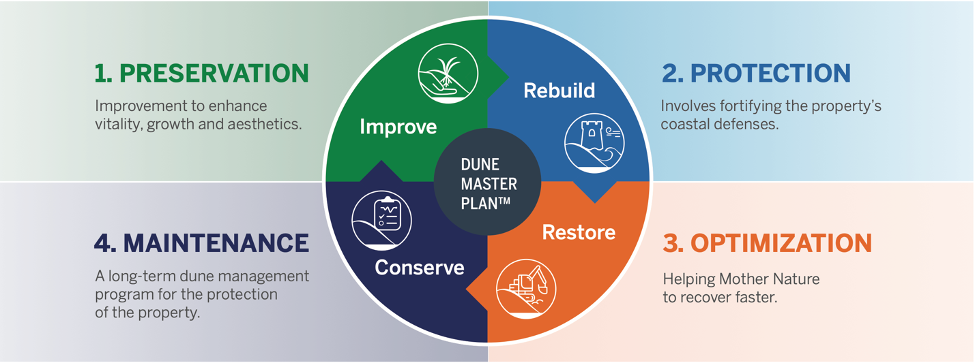
The Dune Master PlanTM (DMPTM) is a comprehensive and proactive long-term plan for coastal resiliency. Much like a landscape architect’s plan, the DMPTM provides a roadmap to ‘what good looks like’ and allows the flexibility of both scope and time based on your needs and budget. The four phases that make up the Dune Master PlanTM are Preservation, Protection, Optimization, and Maintenance.

Symptoms that Phase 1: Preservation Addresses

Thatch

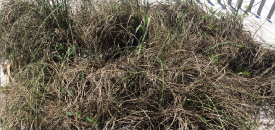
Thatch is the build-up of dead plant material around the base of the plants. It is highly flammable when dry; and, if wet, thatch provides a hospitable environment for diseases that can kill the plant.  

dry, dead plant material clumps around the base of dune-building vegetation.
Thatch

Dune Fires

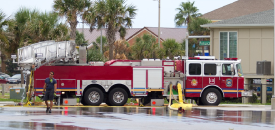
If dead plant material (thatch) is allowed to accumulate throughout the dune, a single spark (from cigarettes or fireworks) can ignite dry thatch and damage living plants in the process. From experience, native dune vegetation does not recover well from a fire. 

Fire Fighters visit Property in Destin whose dune caught on fire
Watch the Testimonial of the client who was impacted by a dune fire here.

Invasive Plants

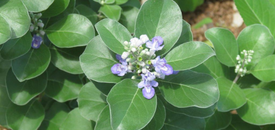
Invasive vegetation can crowd out the dune environment. They will compete with and may risk displacing the native plants. Because invasive plants have not coevolved with the environment, they do not fulfill the same ecological functions as native vegetation. They cannot anchor sand in place as effectively and should be removed carefully.

Beach Vitex is a Common Invasive Plant
to the Gulf Coast.

Protected Scrub Zone

The scrub zone, boasting woody shrubs and trees, can sometimes be negatively impacted by aggressive vines that grow over the canopy. The vines block sunlight and the trees begin to wither. The height of certain trees may also occasionally obscure an ocean view, so some property owners may wish to trim down their scrub zone. Due to the valuable root systems of the scrub zone, the Department of Environmental Protection only allows Coastal Restoration Experts to remove 12 inches max from the height of the scrub zone’s canopy.

NOTE: Any unauthorized work in the scrub zone will result in legal consequences, in addition to severely threatening the stability of the property’s dune.   


What Solutions does Phase 1: Preservation Provide? 

The work we recommend implanting in Phase 1 addresses the issues listed above by revitalizing the native vegetation on your existing dune.

Through Phase 1, Dune Doctors:

  • Delicately removes any thatch (dead plant material), build-up of trash, and detrimental plants from the dune system.
  • After extracting these harmful elements, our restoration experts fertilize the native coastal vegetation to strengthen their root systems. (Click here to learn more about dune fertilization.)

Symptoms that Phase 2: Protection Addresses


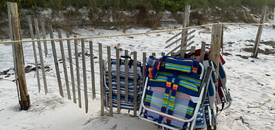
Broken, Buried, or Incorrectly Installed Sand Fences 

When our Coastal Restoration Experts encounter sand fences on a property, they are typically in three different states: broken, buried, or incorrectly installed.

Remember to encourage Beach Goers to not store items on sand fences to avoid breaking the structure.

What are the impacts of broken, buried, or incorrectly installed sand fences?

  • The jagged edges of broken fences present a safety hazard to beachgoers and wildlife.
  • If sand has buried the fences, the fences can no longer capture moving sand, slowing down the process of an even sand accretion across the width of the property.
  • If sand fences are installed incorrectly and do not follow environmental regulations, the installation will also pose a hazard to wildlife and beachgoers and may result in legal consequences. 

No Dune System

A coastal property without a dune system risks the loss of ground-level structures at the slightest storm. Storm surge will quickly plow landward and crash full force into waterfront buildings, resulting in structural, economic (indefinite closure will cause revenue loss), and environmental damages (the wave action will carry debris along the coast and further inland). 

Dune Doctors constructed a dune for the property above. Click here to view the transformation!

Regulatory Issues 

Regional, state, and federal authorities oversee the protection and development of the coastline. Obtaining the necessary permits from these different organizations can be challenging, but unauthorized restoration efforts may result in hefty fines. 

Attempting to contact a Regulatory Agent?
Click here to access our contact list for FL & AL.

What Solutions does Phase 2: Protection Present? 

Through Phase 2, Dune Doctors resolves the issues above by:

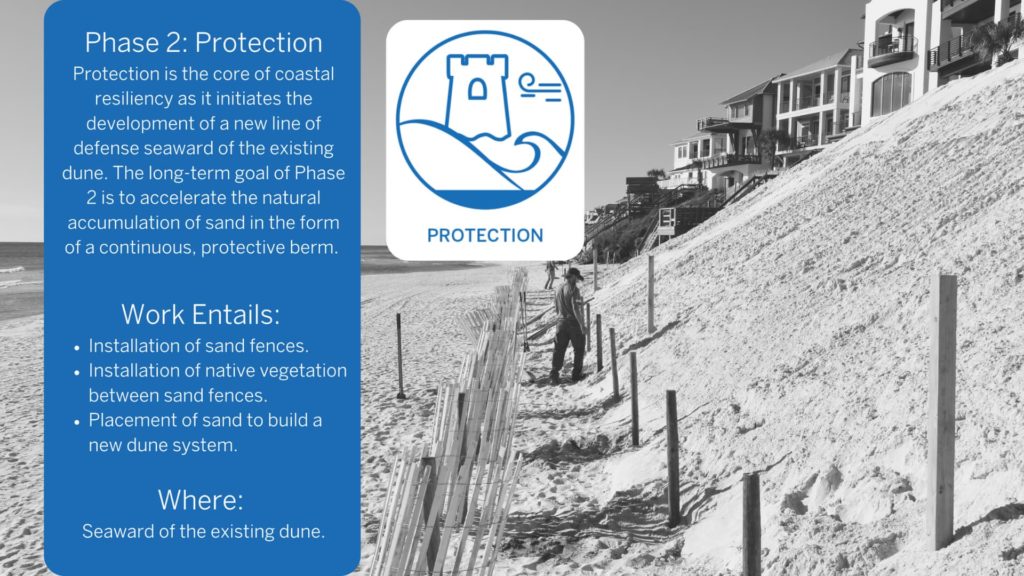
  1. Obtaining all necessary permits on your behalf to build a new dune system or implement work seaward of your existing dune.
  2. Installing environmentally compliant sand fences and dune-stabilizing native grasses and flowers to encourage sand accretion (build-up) in the shape of a berm (a berm is a continuous sand barrier even in distribution and height that extends along the entire property’s width).
  3. Installing no-trespassing signs to discourage beachgoers from walking on the developing berm. (Click here to find out more ways to protect your berm.)
  4. Roping off a pathway from the bottom of the boardwalk through the vegetation to the fences to limit foot traffic erosion and create safe passage for beachgoers.

Symptoms that Phase 3: Optimization Addresses


Bare Areas 

If a dune has un-vegetated, bare areas, wind, and wave action will erode the loose sand resulting in irregular depressions throughout the dune. Vegetation is critical to stabilizing dune systems. Ground covers exhibit sprawling, surface-level growth that retains sand while other dune-building grasses weave complex root systems through the core of the dune, anchoring the sand in place. 

No Native Vegetation 

After a storm, we sometimes find that communities relocate large piles of sand to replace eroded dunes, which is excellent; however, without installing native vegetation to stabilize the new mound, the loose sand will rapidly erode at the slightest storm event. Bare sand mounds cannot protect coastal communities against the pounding action of storm surge (continue reading about the formation of dunes here).

Foot Paths 

Coastal vegetation is the primary coastal force stabilizing dunes and protective berms. While the plants can survive temporary inundation, scorching sunlight, and salt spray, they cannot survive the localized pressure of a footstep. Foot traffic kills vegetation and, in the process, weakens the dune.

Boardwalks 

The regulatory purpose of a boardwalk is to provide safe passage to beachgoers while not disturbing the development of coastal dunes. Erosion occurs around a boardwalk in two main ways.

  • If a dune has evolved past the boardwalk, foot traffic will create a non-vegetated depression en route to the beach.
  • Another common issue is stormwater run-off channeling below the boardwalk. If not addressed, this destructive water flow will undermine the stability of the boardwalk by eroding the sand from around its foundation. 

Sand Relocation  

Development has impacted coastal wind flows, resulting in odd sand distribution patterns. Often, wind erodes sand from around the corners of waterfront buildings or paved pathways and pushes the sediment to undesirable places like the community pool deck. If not addressed, this erosion may result in cracked foundations and create a costly structural and safety hazard. 

Dune Blowouts and Dune Cliffs

A dune blowout occurs when a storm surge breaches the dune system and severely erodes sand along the water’s pathway. A dune cliff is when water does not breach, but it carves out the dune, resulting in an unnaturally shaped vertical wall of sand. Both severely threaten the integrity of the dune system and present safety hazards to beachgoers and wildlife (How to Protect beachgoers from Collapsing Dunes).

Loss of Beach  

During a storm, destructive wave action erodes sand from the beach and usually deposits the sediment in pockets right offshore. If given a few weeks, wave and wind action will likely push some of the sand back landward. As scary as a severely eroded beach may look, we often encourage people to be patient and wait for the beach to start recovering its width naturally. 

What Solutions does Phase 3: Optimization Provide?

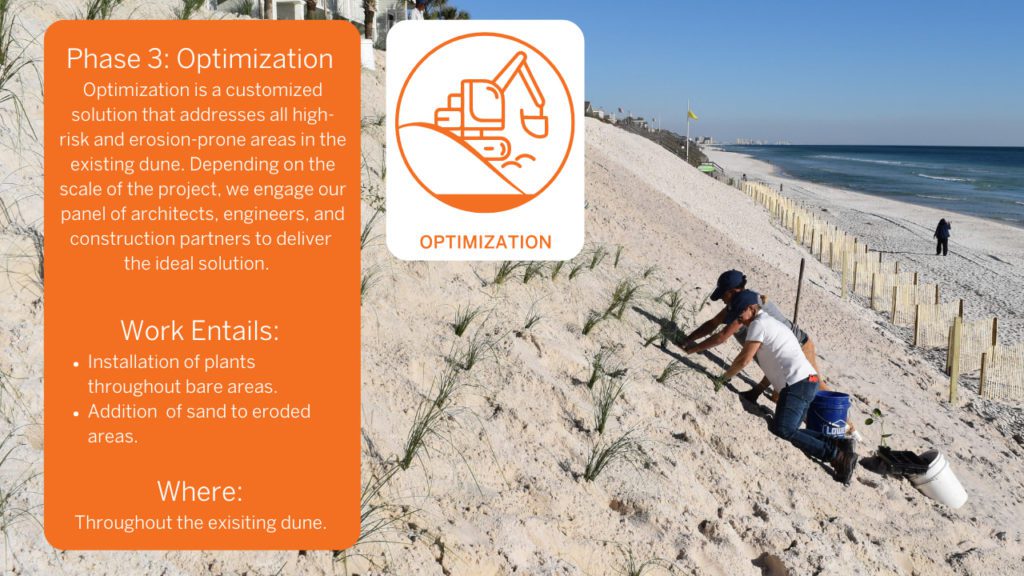
Phase 3 addresses the issues above by optimizing and strengthening your existing coastal dune:

  1. Dune Doctors identifies erosion threats and, if needed, strategizes construction solutions, including installing a new boardwalk that accounts for the dune’s seaward evolution or the placement of large volumes of sand to repair erosion.
  2. Our Coastal Restoration Experts install native plants to stabilize bare areas throughout the dune and property.
  3. Dune Doctors plant coastal flowers to enhance the natural aesthetics of the dune and increase plant diversity. View our plant selection here.

Issues that Phase 4 Maintenance Addresses  

Aesthetics

 Coastal communities sell one main product: their beach. Unruly dune environments can take away from the aesthetic appeal and may negatively impact renters’ perception of the property.

Invasive Pests 

 The presence of pests indicates a trash extraction problem. Invasive predators like rats can quickly colonize a dune system (especially one overrun with dead plant material) and attract snakes, lowering the aesthetic value of the coastal property and threatening native wildlife. 

Irrigation 

 An irrigation system that reaches the dune undermines the capacity of native vegetation to stabilize the sand. A consistent surface-level source of moisture will result in weaker, shorter root systems that cannot effectively protect against erosion. Any irrigation will nullify Dune Doctors’ plant survival guarantee. 

Fertilization

Coastal vegetation has evolved to survive its nutrient-deficient environment, but, sometimes, well-meaning homeowners attempt to encourage their plants’ growth by applying the wrong fertilizer (intended for composite soil) on their dune. The fertilizer will wash away before the plants can absorb any nutrients. This incompatible fertilizer unnecessarily pollutes the environment and is a chemical hazard for beachgoers and wildlife.  

Issues that Phase 4 Maintenance Addresses  

Through Phase 4, Dune Doctors addresses all of the issues above by:

  1. Performing quarterly visits to monitor the development of your dune system and make recommendations based on our findings. The visits align with the growing cycle of coastal vegetation.
  2. Gently removing invasive plant species, debris, and dead plant material (thatch) while the plants are dormant.
  3. Fertilizing the existing plants while the plants are active.
  4. Installing native coastal flowers and stabilizing grasses to bolster both the dune’s aesthetics and integrity.

Schedule Your Dune Health Assessment Today! 

If you detect that one or more of these issues may be present on your coastal property, contact Dune Doctors to request a Dune Health Assessment. Our team will walk your coastal landscape with you and point out problem areas that can be corrected and improved. Rest assured that the Dune Master Plan™ can resolve all the issues above. Reach out to our team today to schedule your first site visit, and let us develop a long-term vision for your coastal property together! 


Filed Under: Maintenance, Preservation, Protection

The Formation, Erosion & Maintenance of Coastal Dunes

December 14, 2021 by Frederique Beroset MBA & M.S. in Biology

An introduction to the different forces that shape your protective coastal landscape.

Article Highlight: Wind, water, and vegetation are the three primary forces that contribute to the formation and erosion of coastal dunes. 

Key Takeaway: While the contour of the coastline changes daily, proactive waterfront homeowners can work with Dune Doctors to implement an environment-specific plan that aligns with coastal cycles and encourages sand to accumulate on their property.

Application: Call 866-386-3737 today to request a Dune Health Assessment of your coastal property. Have our team repair erosion-prone areas on your existing dune and determine the optimal location to initiate another natural barrier. 

How do Coastal Dunes Form?

In short, coastal dunes are vegetated sand mounds that form along beaches where sand is available. As different coastal forces carry sand onto and along the beach, particles collide with obstacles, like sand fences and native grasses, and drop, accumulating where they fall and initiating a dune. If undisturbed, native vegetation will hold the sand in place, and the dune will slowly increase in size. Over time, multiple rows of dunes will form, between the beach and the woody scrub zone. Wind and water action continuously reshape the coastal environment, so dunes tend to grow, shrink, and move following prevailing winds. 


Why Should Coastal Communities Care about their Dunes?

Communities that have introduced permanent structures into this dynamic ecosystem benefit greatly from working with Coastal Restoration Experts to limit dune movement. Dunes are nature’s first line of defense against the destructive impacts of storm surge. To achieve sustainable resiliency, Dune Doctors encourages coastal homeowners to view their dune system as a valuable asset that must be invested in, respected, and cared for. Through the strategic restoration and maintenance of this protective landscape, Dune Doctors helps waterfront property owners strengthen their existing dune(s), add environment-specific sand to correct erosion, and initiate new, continuous berms (a continuous protective barrier even in height and sand distribution) that encourage sand accretion (sand build-up) across the width of their property. 


What Physical Forces Build and Erode the Coastline?

Two physical forces push sand along the beach: winds and tides. The wind moves sand in two ways by blowing it along the beach and by forming waves. The wind speed, the duration of the wind, and the fetch (how wide the body of wind is) all determine how much sand the wind will move and the size and strength of the waves it will form. Waves crash onto the beach and deposit or erode sand from the swash zone (the area where waves run up and down the beach). A wave deposits sand on the beach if it loses most of its energy while pushing landward. The daily variance in the tide level also plays a critical role by exposing different beach sections to wind and wave action. The tide can also transport sediment. Whether or not these forces will take (erode) or deposit sand (accrete) is determined by a combination of environmental factors, including geological predisposition to erosion or accretion, the width and slope of the beach, moisture, vegetation present, weather, and sand availability. 


How Does Wind Transport Sediment to Build Coastal Dunes? 

The process by which wind pushes sand is called aeolian transportation, and it occurs in three forms: suspension, saltation, and creep. Suspension is when sand is picked up and carried in the wind. Saltation is when the sand particles bounce along the beach, while creep is when sand particles collide and push each other. Coastal homeowners can take advantage of aeolian transportation by working with Dune Doctors to strategically introduce obstacles (sand fencing and vegetation) along their beach to build up and stabilize sand on their property. 


How Does Wave Action Help Build Sand Dunes? 

The impact of waves starts offshore in the surf zone, where waves crest and break due to friction between wind and the surface of the water and the decrease in depth, as the water approaches the beach. This breaking motion creates turbulence that generates currents and swirls sand upward.  The currents can flow parallel (called a longshore current), perpendicular, or cross-shore called undertows and rip currents. These currents then push the sand while some waves, called the swash, surge up through the swash zone between high and low watermarks on the beach. When the swash has greater forwarding momentum than retreating energy, some of the water sinks into the beach and deposits wave-borne particles in place. During a single storm, sand particles can move from the beach to sand bars way offshore in minutes or be pushed a couple of miles down the beach in a matter of hours.  


How Does the Tide Help Build Sand Dunes? 

Tides play two roles in sand movement it can transport sediment and distribute wave energy by changing the depth of the water and the position of the shoreline. The moon’s gravitational pull and earth’s rotational force determine the tide’s height. Depending on whether there is a high or low tide, the beach will be narrower or broader, exposing different beach areas to the processes discussed above. The daily changes in the tide level are why the coast’s contour may look completely different from morning to night.


How do Coastal Plants Encourage the Formation of Dunes? 

Pioneer grasses like Sea Oats and Panic Grass grow towards the sea and are the first to stabilize a habitat after a destructive storm. These plants have complex root systems that weave through the sand, creating massive webs that anchor dunes in place. In addition to the grasses, other plants also play vital ecological roles in sustaining robust dunes. Ground covers help retain sand while flowers improve the environment’s aesthetics and provide food and protection for beach wildlife. Orencio Duran and Hans J. Hermann developed a set of equations that analyzed the ratio between the “dune erosion rate and vegetation growth velocity (4).” In 2013, Duran extended his modeling to include ecological and physical effects observing fundamental interactions between wind flow, sand transport, topography, the shoreline, and vegetation. His research argued that “plant zonation (plant zonation is the distribution or arrangement of plants in a habitat determined by environmental factors), rather than sediment supply, controls coastal vulnerability to storms by determining maximum dune size (4).” Through his research, Duran observes that without vegetation coastal dunes will only reach a limited height before dissipating. In other words, Duran recognizes that dunes are critical barriers that protect waterfront communities from destructive waves and suggests that dune-building vegetation plays a critical role in determining the size and resiliency of coastal dunes. 


How to Align Restoration Efforts with Coastal Forces

The best way to build sustainable coastal resiliency is to strategize restoration efforts that take physical (wind and waves) cycles and ecological (vegetation) processes into account. Different solutions include beach renourishment, dune construction, sand fencing, and coastal vegetation. Communities with eroding shorelines may invest in beach renourishment and artificially add sand to widen their beach. A greater beach area heightens protection against storm surge and increases sediment availability for dune growth. Property owners with no protective dune can work with Dune Doctors to artificially construct a dune by placing and sculpting sand berms and then stabilizing the loose sand with vegetation. Alternatively, or in conjunction to beach renourishment, communities can install sand fences paired with dune-building plants to limit sand movement and initiate a protective berm in a location most advantageous to them. Finally, investing in high-quality plants is critical to sustaining protection against storm surge. Dune Doctors has a dune maintenance program that provides season-specific care based on the yearly cycle of dune-building grasses. Reach out to Dune Doctors today to schedule a Dune Health Assessment and have our coastal restoration team evaluate the potential failure points of your dune system and develop personalized solutions that reflect the unique environmental condition of your property. 


References and Additional Resources:

1. “Beach and Shoreface Nourishment.” Climate Adapt, OURCOAST II Project, https://climate-adapt.eea.europa.eu/.

2. “Coastal Effects of Tides.” U.S. Army Engineer Institute for Water Resources (IWR), https://www.iwr.usace.army.mil/Missions/Coasts/Tales-of-the-Coast/Coastal-Dynamics/Tides/.

3. Davis, Richard Albert. “Depositional Systems: An Introduction to Sedimentology and Stratigraphy.” Google Books, Prentice Hall, https://books.google.com/books/about/Depositional_systems.html?id=x08SAQAAIAAJ.

4. Durán, Orencio, and Laura J. Moore. “Vegetation Controls on the Maximum Size of Coastal Dunes.” PNAS, National Academy of Sciences, 22 Oct. 2013, https://www.pnas.org/content/110/43/17217.

5. US Department of Commerce, National Oceanic and Atmospheric Administration. “Why Does the Ocean Have Waves?” NOAA’s National Ocean Service, 1 June 2013, https://oceanservice.noaa.gov/facts/wavesinocean.html. 

6. “Voyager: Why Does Sand Move and How Does It Get from Place to Place?” Scripps Institution of Oceanography, 1 May 2008, https://scripps.ucsd.edu/news/voyager-why-does-sand-move-and-how-does-it-get-place-place.

Filed Under: Education, Maintenance, Preservation, Protection

9 Coastal Plants that Initiate, Restore and Stabilize Coastal Dunes

December 9, 2021 by Frederique Beroset MBA & M.S. in Biology

An introduction to 9 native plants that grow on the pioneer and primary dunes of the Gulf Coast.

Article Highlight: Native vegetation help initiate, develop, stabilize, and enhance coastal dunes. Proactive coastal homeowners that invest in native coastal plants reap the benefit of a synergistic, healthy dune system.

Key Takeaway: Each coastal plant serves an ecological function. Therefore, it is critical to use a diverse sampling of native vegetation when restoring dune ecosystems.

Application: Have Dune Doctors acquire and install dune-stabilizing vegetation on your property. Our method guarantees that 95% of plants will be thriving at the 3-month mark.

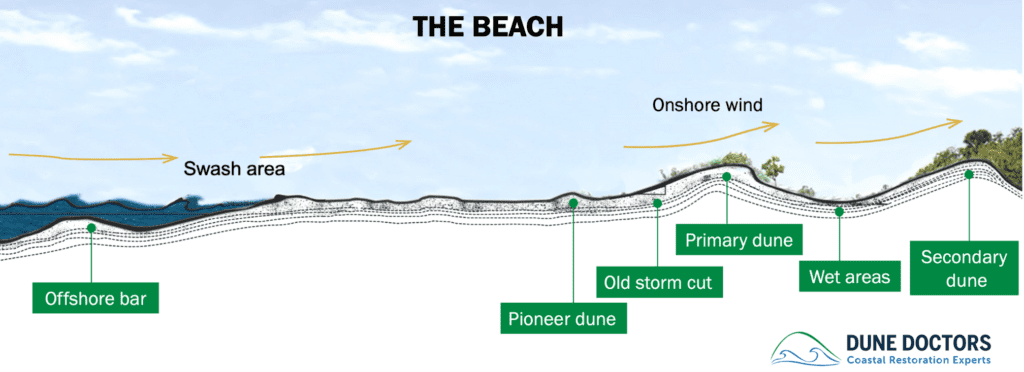
The Gulf Coast’s plant life is varied and dynamic. Along high-energy beaches with pounding wave action, vegetation typically does not spread seaward into the swash zone (where waves run up the beach). The swash zone is the boundary between land and water. Landward of the swash zone lies the rest of the beach and the pioneer dune. Vegetation that initiates the pioneer dune (the developing dune closest to the water) are well-adapted for periods of temporary flooding and can survive being submerged by abnormally high tides and floods. As dune-building grasses grow seaward, sand accumulates around them resulting in the initiation of the pioneer dune. As pioneer dunes increase in height, they will grow and start to connect with other pioneer dunes, eventually forming a new primary dune (the established dune closest to the water).

Mature dunes (secondary, tertiary, etc.) lie behind the primary dune and hold a greater plant diversity because they face less environmental stressors (salt spray, temporary inundation, sand blasts). As these dunes accumulate more organic material, woody vegetation will colonize them, developing into a scrub zone and, eventually, a maritime forest. Given the variety of plants that grow throughout these unique coastal areas, appropriate plant selection and installation are critical. The vegetation needed to restore a primary dune is different than what would be used to restore the scrub zone.

Dune Doctors focuses on helping communities achieve sustainable coastal resiliency by enhancing the protective role coastal dunes play in limiting the impact of destructive storm surge. Therefore, we focus on addressing erosion-prone areas throughout the primary dune and on initiating the development of sand berms. Located seaward of the primary dune, sand berms are continuous sand barriers that accumulate sand evenly in height and distribution across the width of the property. We initiate sand berms with the combined use of sand fences & native vegetation. In both cases, our Coastal Restoration Experts work with native vegetation that typically grows on the pioneer and primary dune. Our plant selections are custom-grown and help accelerate sand accretion (the build-up of sand) and stabilize dune systems. Below are the nine coastal plants that our Coastal Restoration Experts routinely work with.

THE GRASSES – DUNE INITIATION & STABILIZATION

When exploring the Gulf Coast, you will typically encounter 3 kinds of plants that propagate (spread) towards the sea: the Sea Oat, Panic Grass and Saltmeadow Cordgrass. As pioneer plants, they have adapted to the extremes of the coastal environment and can be considered first responders because they are the first plants to colonize the beach after storm damage. They are responsible for the development of pioneer dunes, in addition to helping limit coastal erosion.

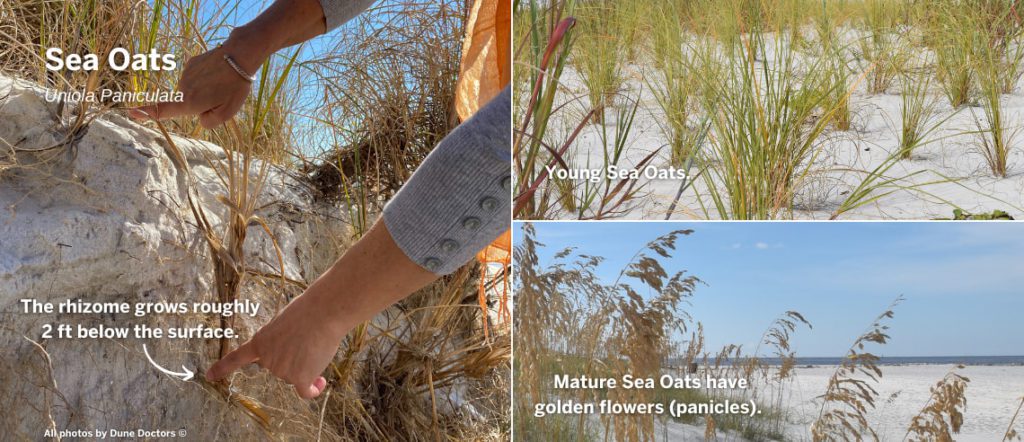
Sea Oats – Uniola Paniculata 

Sea Oats Installation by Dune Doctors

Sea Oats are the primary dune-stabilizing plant located along the Gulf Coast. This plant can survive its nutrient-poor environment because it gains mineral nutrients from the sand, salt spray, and its decaying matter. According to Carrie Stevenson the Coastal Sustainability Agent for the UF Escambia County Extension Office, Sea Oats’ roots can grow roughly 40ft and extend in all directions in search of the scarce nutrients and water buried within the core of the dune (8). This root growth functions as a complex web that anchors the sand in place. Sea Oats also propagate seaward via rhizomes (underground horizontal stems) that sprout new plants.

Their seeds are a source of food for beach-nesting populations including birds, crabs and beach mice. Its leaves grow from the meristem located at the plants’ crown (where the stem meets the root system). If a footstep crushes the meristem, the plant will die, and it can no longer fulfill its ecological function of holding sand in place. Signs that say “Please Stay off the Dunes” are in place to protect plants from foot traffic. 

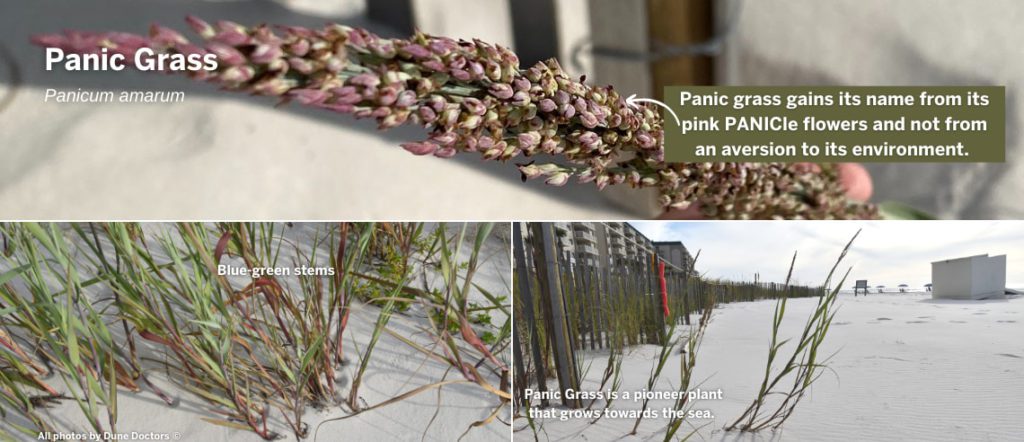
Panic Grass – Panicum amarum

Panic Grass installation by Dune Doctors in Perdido Key Beach

Growing alongside Sea Oats in the pioneer and primary dune, the blue-ish green Panic Grass is another plant that stabilizes and builds coastal dunes. This plant mainly propagates seaward via nodes along its stem and is clump-forming (tends to grow in groups). The common name “Panic” grass does not originate from the plants’ aversion to its challenging environment but its seed-bearing PANICles (a loose branching cluster of flowers).

Research conducted by Rusty J. Rodrigues revealed how this grass is able to survive the stress imposed by salt spray and dry conditions. His testing demonstrated that Panic Grass holds a symbiotic (a mutually beneficial relationship) relationship with water-absorbing fungi present on its roots resulting in a more “efficient use of water:” drought tolerance (5). Blair Witherington describes this relationship as follows, “the water-absorbing fungi (mychorrhizae) send out microscopic tendrils (mycelia), thinner than the tiniest root, that vastly increase the cooperative (plant’s and fungi’s) surface area for absorbing water and nutrients. (10)”

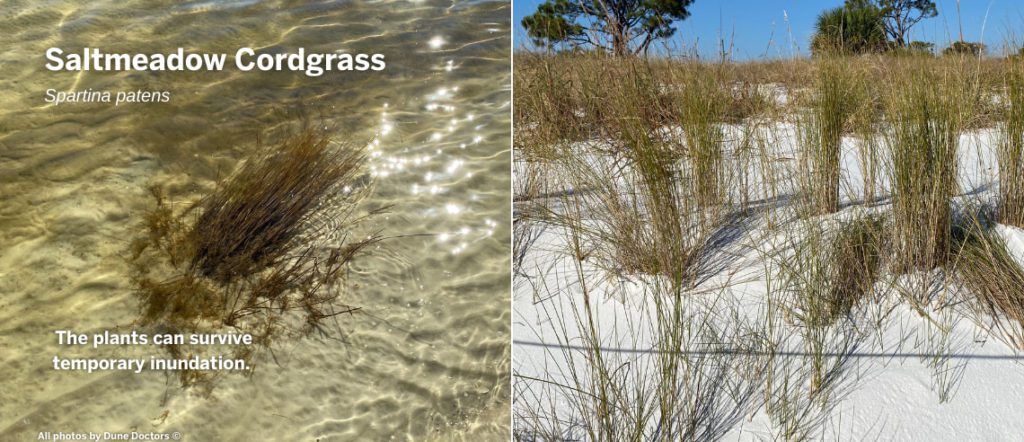
Saltmeadow Cordgrass – Spartina Patens 

Saltmeadow Cordgrass is a tufted grass native to the Gulf and Atlantic Coast. The plant can survive being temporarily submerged in saltwater and is, therefore, typically the most seaward-growing plant. According to the United States Environmental Protection Agency, the plant has adapted to this environment by secreting salt from glands in its leaves (6).

The plant exhibits a rhizomatous clumping growth pattern that results in dense tufts of grass and helps absorb some of the destructive energy brought forth by waves. For this reason, Dune Doctors installs this plant in tidal marsh restorations projects as well as at the base of developing dunes along the coast. Saltmeadow Cordgrass helps limit erosion by stabilizing sand and absorbing some wave energy before it reaches land. The plant’s seeds also provides food for beach-nesting populations and algae that grows on the leaf’s surface provides food for grazers like the periwinkle snail.  

GROUND COVERS – SAND RETENTION

The ground covers exhibit sprawling growth along the surface of the dune and retain sand in place allowing for the dune to increase in height.

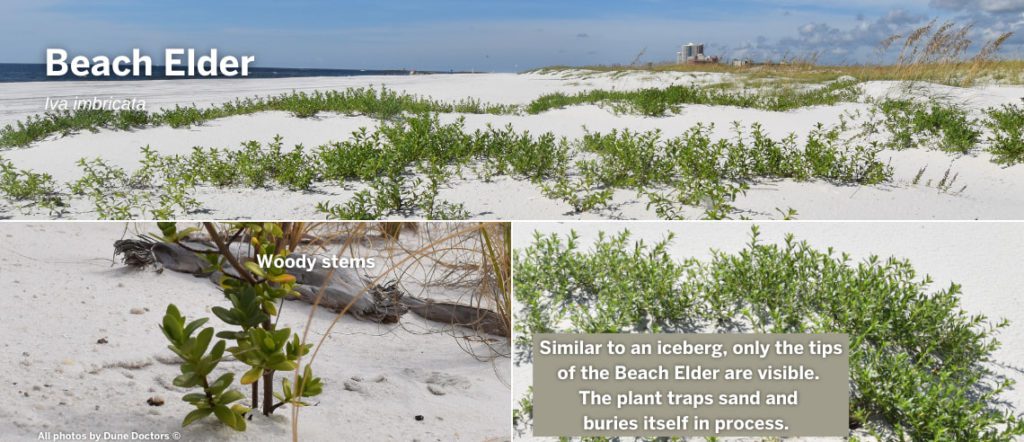
Beach Elder Iva imbricata

Beach Elder plays a critical role in restoring, stabilizing, and forming coastal dunes because of its ability to trap sand. The succulent, shrub-like perennial woody plant can reach heights of 1 to 4 ft and widths of up to 6 ft. As moving sand particles collide with the stems and accumulate in place, the portion of the stem below the surface responds to being buried by producing roots. Typically, the Beach Elder grows on the flat of the beach and helps initiate pioneer dunes.

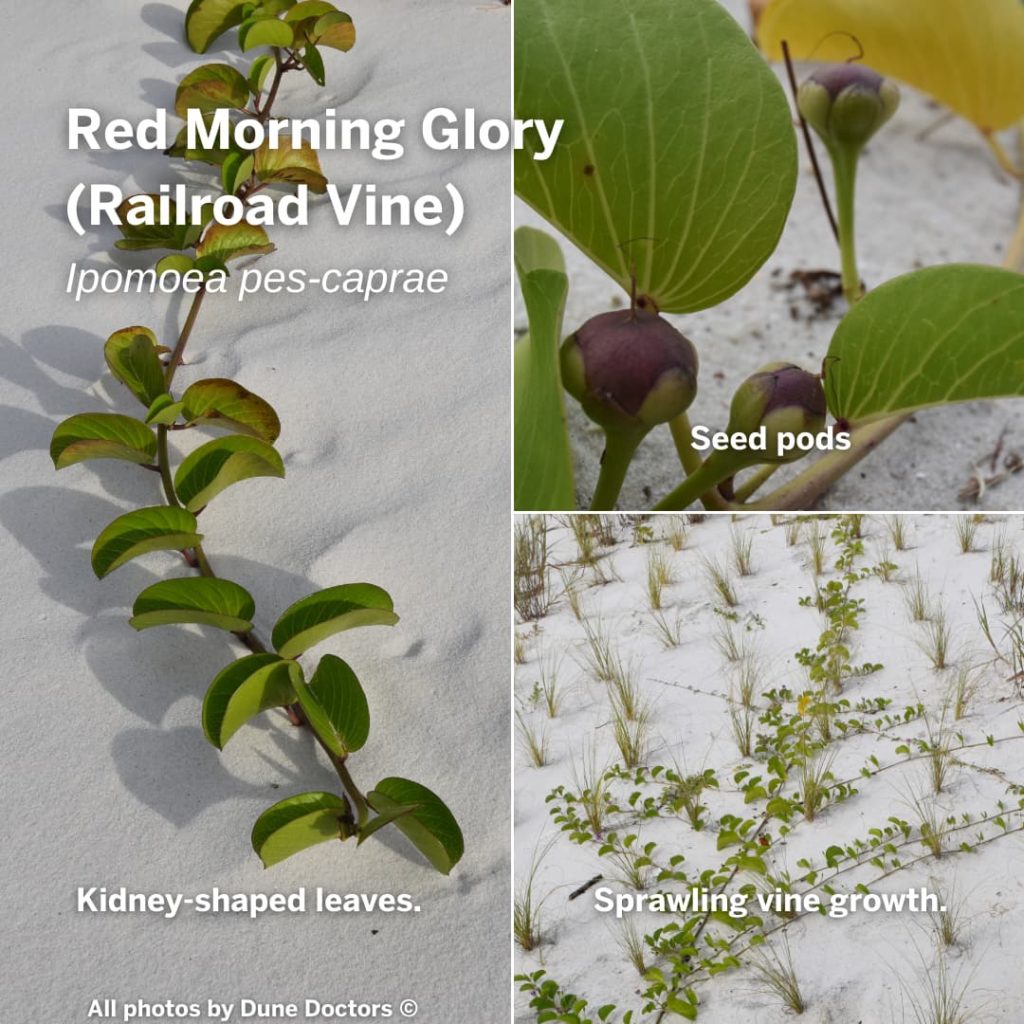
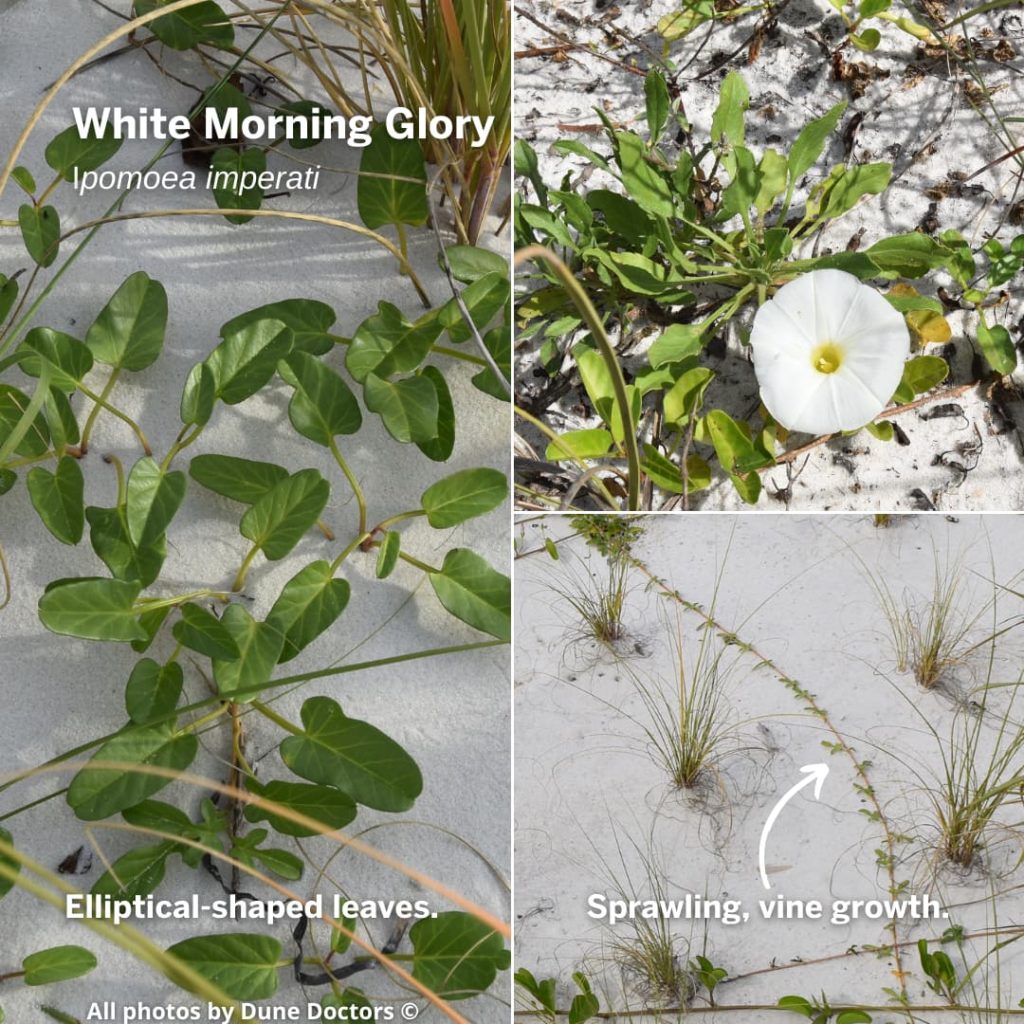
White Morning Glory Ipomoea imperati and the Red Morning Glory (Railroad Vine) Ipomoea pes-caprae

Two Ipomoea species grow along the Gulf Coast, the Beach Morning-Glory and the Railroad Vine. Both are stoloniferous and grow horizontal stems that can grow upwards of 30ft, covering the dune’s surface. The plants play a critical role in the dune ecosystem by stabilizing sand and providing seeds for several types of wildlife, including the endangered beach mouse.

The difference between both ground covers is the shape and size of their leaves, the thickness of their stem, and the color of their flowers. White Morning Glory produces white flowers and has a velvety leaf that has three lobes. Whereas the Railroad Vine has a significantly thicker stem, purple flowers, and kidney-shaped leaves. Both plants tend to die back during the winter and return in the spring. However, they can both flower year-round depending on where they are located.

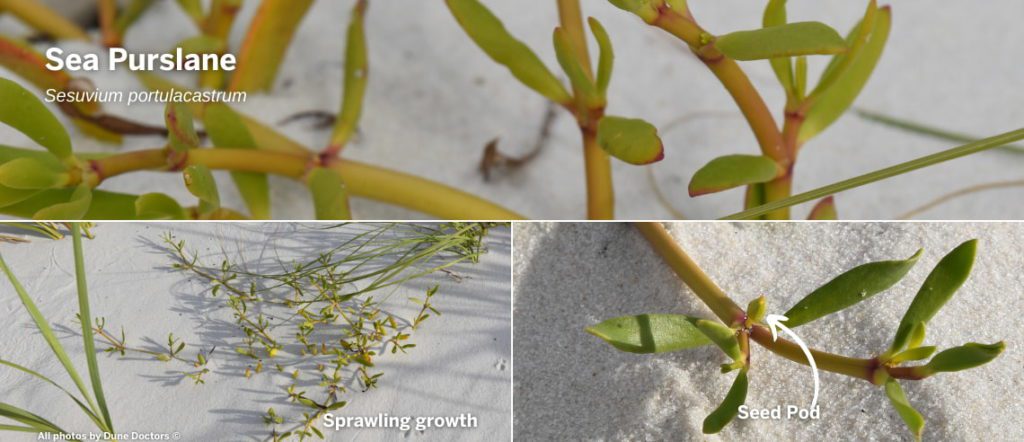
Sea Purslane Sesuvium portulacastrum 

Sea Purslane, another ground cover, is a succulent that develops from the primary dune towards the upper beach. Similar to the other ground covers, it helps limit the movement of sand along the surface of the dune. The sea purslane blooms year-round, but their starlike flowers do not have petals, only five purple sepals (the portion of the flower that typically encloses petals). The Sea Purslane’s value extends beyond the dunes! The plant is consumed worldwide and has the common culinary name: Sea Pickle. 


FLOWERS – VIBRANT FOOD SOURCES

The dunes also host a colorful arrangement of flowers whose seeds feed beach nesting birds, mammals, crustaceans, and insects. In addition to fulfilling this critical ecological function, these flowers also add color, increasing the aesthetic value of the dune. These salt-tolerant beauties can grow on the seaward facing slope of the primary dune.

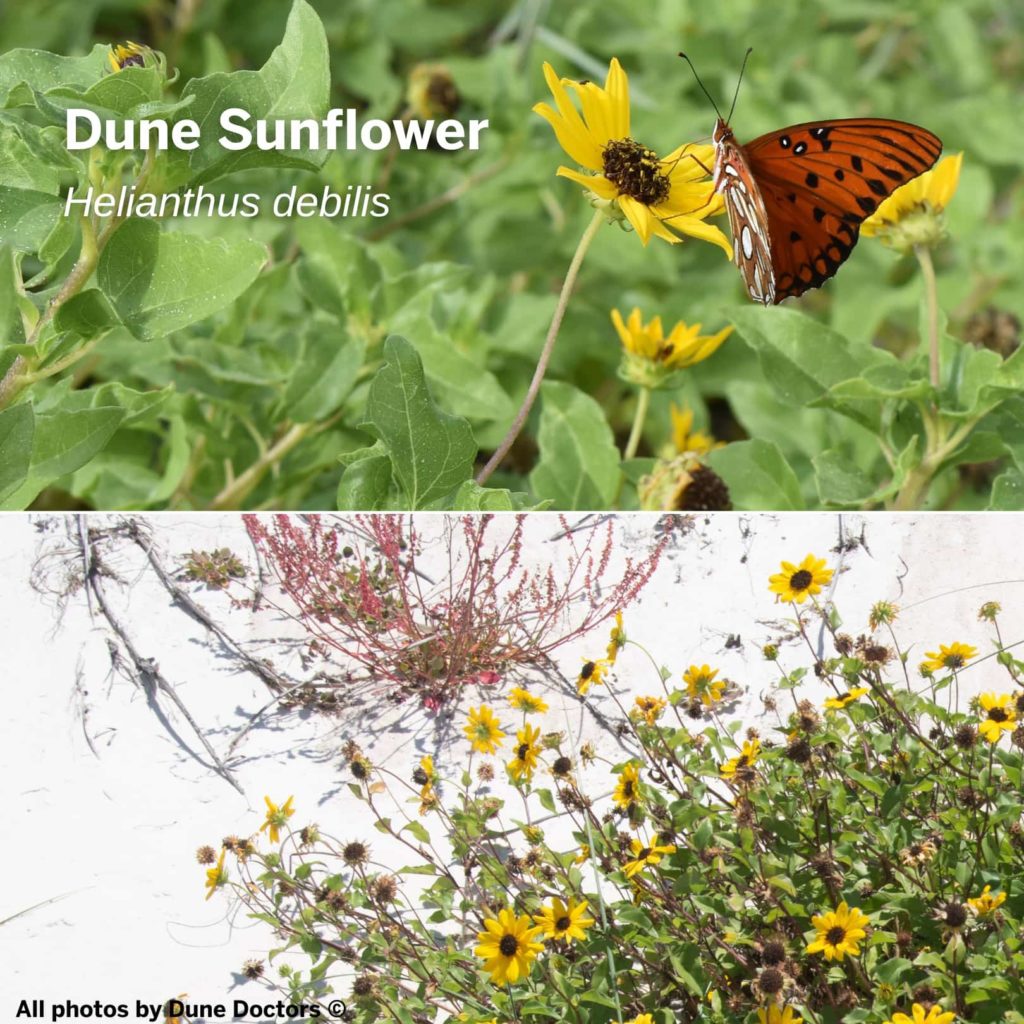
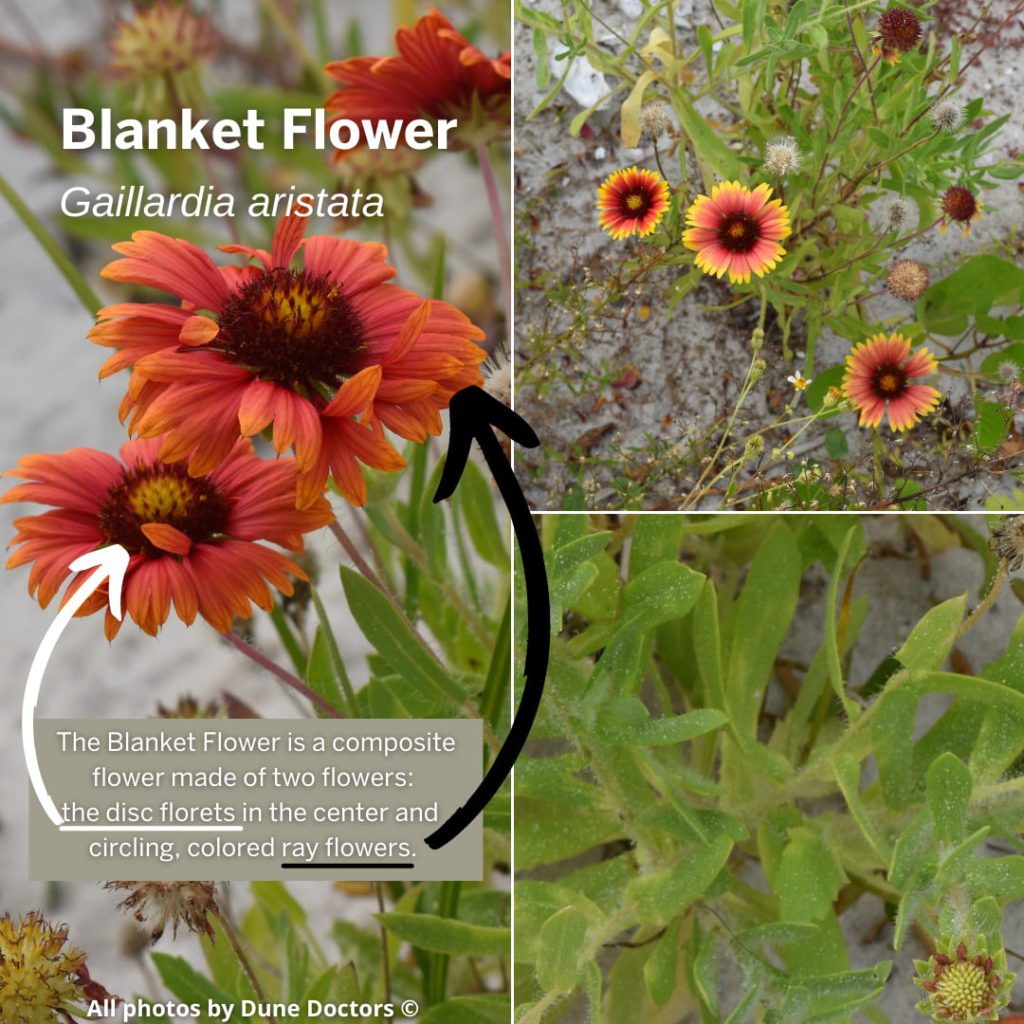
Dune Sunflower – Helianthus debilis & the Indian Blanket Flower – Gaillardia aristata

Dune Sunflowers and Indian Blanket Flowers are part of the aster family because their flowers are composite. Composite flowers produce two kinds of flowers: tightly packed brown disc flowers that make up the “eye” of the flower and enlarged ray flowers that function as petals! These brightly-colored composite flowers attract pollinators, and the plants’ tendency to grow in dense patches provides shelter for dune wildlife. These plants are highly salt-tolerant and can grow on the primary dune. While they play a minor role in dune-stabilization, they are critical to the native dune wildlife. 

How Dune Doctors Selects the Native Vegetation for our Restoration Projects

When strategically initiating or stabilizing a coastal dune, Dune Doctors uses a variety of plants with different characteristics that each fulfill a specific role. Our team considers the ecological and human-oriented functions such as erosion control, stabilization, and aesthetic enhancement. The Florida Sea Grant Fund and the University of Florida demonstrated that the geographic source of the dune-stabilizing vegetation was a significant factor in the plants’ survival rate when planted in a different location. Therefore, to increase survival rates and protect native ecosystems, Dune Doctors works with regional vegetation coevolved with the environment undergoing restoration.

The dune’s vegetation is the primary natural force limiting sand movement and countering erosion. Because dune systems play a critical role in protecting waterfront communities from destructive wave actions, governmental authorities protect dune-stabilizing native plants on local, state, and federal levels. In all cases, Dune Doctors strives to restore the protective dune environment by using hybrid strategies that pair native vegetation with other construction efforts like sand fencing and sand placement.

Our team of Coastal Restoration Experts can help you obtain proper permitting and implement all restoration efforts on your behalf. Speak with us today at 866-386-6767.


References and Additional Resources:

1. Barnett, Michael R., and David W. Crewz. Common Coastal Plants in Florida: A Guide to Planting and Maintenance. University Press of Florida, 1997.

2. Brown, Stephen. “Helianthus Debilis Family: Asteraceae – Blogs.ifas.ufl.edu.” Ufl.edu, University of Florida, https://blogs.ifas.ufl.edu/leeco/files/2017/05/lee-county-beach_dune_sunflower_Helianthus_debilis.pdf. 

3. Hazell, Joy, et al. Sea Oats Uniola Paniculata. University of Florida , https://files1.revize.com/revize/capecoralfl/document_center/Sea_Oats.pdf.

4. Miller, Debbie. Dune Restoration and Enhancement for the Florida Panhandle. University of Florida, https://edis.ifas.ufl.edu/pdf%5CSG%5CSG15600.pdf.

5. Rodriguez, R., Henson, J., Van Volkenburgh, E. et al. Stress tolerance in plants via habitat-adapted symbiosis. ISME J 2, 404–416 (2008). https://doi.org/10.1038/ismej.2007.106

6. “S.C. Sea Grant Consortium.” Scseagrant.org, S.C. Sea Grant Consortium, 2015, https://www.scseagrant.org/wp-content/uploads/Spartina-large-portrait-poster.pdf.

7. Setladge, Sharon. “Advancing Sea Oat Biology .” North Carolina Sea Grant Coast Watch, 28 Nov. 2017, https://ncseagrant.ncsu.edu/coastwatch/previous-issues/2012-2/spring-2012/advancing-sea-oat-biology-advancing-dunes/. 

8. Stevenson, Carrie, and Posted: “Weekly ‘What Is It?”: Sea Oats.” UF/IFAS Extension Escambia County, University of Florida, 12 Feb. 2021, http://blogs.ifas.ufl.edu/escambiaco/2020/10/21/weekly-what-is-it-sea-oats/. 

9. Williams, M.J. “Native Plants for Coastal Dune Restoration – NRCS.” Arcs.usda.gov, USDA Natural Resources Conservation Services, 2007, https://www.nrcs.usda.gov/Internet/FSE_DOCUMENTS/nrcs141p2_014913.pdf.

10. Witherington, Blair. Florida’s Living Beaches: A Guide for the Curious Beachcomber. 2nd ed., Pineapple Press.

Filed Under: Education, Preservation, Protection Tagged With: Dune Flowers, Dune Plant List, Dune Vegetation, Ground Covers, Native Coastal Vegetation, sea oats

Sand Fences: How to Build a Stronger Dune System

September 9, 2021 by Frederique Beroset MBA & M.S. in Biology

  • Article Highlight: Installing sand fences and dune-stabilizing vegetation is the most efficient and economical way to build new protective dunes.
  • Key Takeaway: In Phase 2 of the Dune Master Plan™, Dune Doctors employs sand fences and native vegetation to initiate a new barrier, a berm, between the coastal homeowner and water-borne threats.
  • Take Action: Join other forward-thinking communities by calling 866-386-3737 or filling out this form to request a sand fence installation and join our waitlist today. Watch the video below to understand how sand fences build stronger dune systems. 

Why Are Coastal Dunes Important?

Healthy, well-maintained coastal dunes are natural barriers that protect communities and ecosystems from the destructive impacts of storm surge and high waves. In simplest terms, a vegetated dune is a barricade that buys time. A storm will only last so long. Therefore, the greater and healthier the dune, the longer it will take for wave action to breach it and cause damage landward. However, waterfront construction and foot traffic have changed the dynamic of where and how dunes form, leading to weakened protection and heightened erosion. Most coastal communities tend to have a dune system, whether that be an established dune or scattered mounds with sparse vegetation. To increase their protection, Homeowners and Property Managers can work with Coastal Restoration Experts to fortify and enhance this natural barrier. At Dune Doctors, we identify any established dune as the “existing dune,” and the core of coastal resiliency is to strengthen and increase this native landscape by adding berms, seaward of the existing dune.

How Do Sand Fences & Native Vegetation Counter Coastal Erosion?

The evolution of a dune system depends on the cycle of sand accretion (accumulation of sand) and erosion (loss of sand), wind patterns, storm action, sand availability and other environmental conditions. However, because of the combination of natural and man-made factors, this cycle of sand loss and sand accumulation is often unbalanced, and many areas experience heightened erosion. To help coastal communities address sand loss, Dune Doctors works with regulatory agencies to install wildlife-friendly sand fences that are optimized to capture wind-blown and wave-pushed sand. Following environmental regulations, Dune Doctors installs sand fences at a 45 degree angle in alignment with the dominant coastal wind patterns that blow along the Gulf Coast. Moving sand collides with the fences and the particles drop, temporarily accumulating around the base of the fences. While effective in capturing sand, the fences alone cannot hold the sand in place. Therefore, to successfully stabilize the shifting sand, native vegetation must be planted between the fences. As the fences capture new layers of sand, the plants grow through it and anchor it in place with their massive, web-like root systems.

Are Sand Fence Installations Enough to Achieve Coastal Resiliency?

Sand fences fulfill one critical component of achieving coastal resiliency: adding a new barrier seaward of the existing dune. However, installing sand fences without addressing erosion issues and failure points throughout the existing dune undermines the developing berm. Underlying erosion issues may include a storm runoff that drains seaward, an irrigation system that over reaches on to the dune and kills dune-stabilizing vegetation, or a footpath that cuts through the dune creating an area where storm surge is likely to breach the dune. In all three cases, any sand the fences may accrete will not make up for the ongoing erosion. Without a comprehensive approach that cares for the entire dune system, once surge erodes the developing berm, it will easily carve away at the remaining weak landscape and flood ground-level infrastructure. Therefore, the strategy of building new lines of defense needs to align with a concerted effort to optimize and enhance the rest of the dune. To solve the issues impacting an at-risk dune system and strategize ways to increase its protective value, our Coastal Restoration Experts designed the Dune Master Plan™ (DMP™) a long-term roadmap for coastal resiliency. Through four interconnected phases, the DMP™ addresses every aspect of building and maintaining a protective dune system while being in compliance with environmental regulations. The installation of sand fences and native vegetation seaward of the existing dune falls under Phase 2 of our Dune Master Plan™. To obtain a personalized DMP™ contact Dune Doctors today at 866-386-3737 or click here to fill out our contact us form. To read about the three other recommended phases that make our DMP™ a thorough, long-term vision for your protective landscape click here. 

How do Sand Fences Build Stronger Dunes?

Sand fences build stronger dunes by accelerating sand accretion and dune evolution. As sand accumulates and buries the fences, the existing dune behind the row of sand fences also gains sand. Within two to four years, enough sand will accumulate to bury the fences and cause the developing berm and existing dune to merge. Dune Doctors encourages coastal communities to continuously strengthen their native protective landscape by adding new rows of fences and dune-stabilizing vegetation each time a sand fence installation is entirely buried under 4 feet of sand. While the dune’s height is important the continuous form of the barrier is also equally critical. Storm surge will push through grooves and breaks in the protective berm, so proactive neighbors can build protection together by connecting their sand fence installations. As the dune increases in volume, width and length, the likelihood that storm surge will breach it decreases.

How Do Sand Fences Create “Sand Banks”

Sand fences paired with native protective vegetation initiate a “sand bank” in the shape of a continuous protective berm that acts as a buffer between your property and destructive wave action. Over time, the fences capture wind-blown sand, and the plants stabilize each new layer, enhancing and accelerating sand accretion. Think of this “sand bank” as a financial institution that allows for storm events to “withdraw” from your sand savings instead of eroding the dune closest to your property or the foundation of your building. The dune closest to the building, is the dune-of-last-resort. If surge erodes it, the destructive wave action will likely cause extensive damages and force the property to be shut down until all repairs are implemented. Therefore, building up your “sand bank” is critical to avoid these costly damages.

What if a Storm Damages the Sand Fence Installation?

If a storm erodes a portion of the developing berm and compromises the sand fence installation, that does not mean the restoration project failed. The damages are often proof of the installation’s success because that berm, built with free sand, absorbed the brunt of the storm surge and protected waterfront infrastructure. After an installation by Dune Doctors sustains damage, our team repairs the reusable fences and replaces the rest to continue the process of sand accretion. While it takes two to four years for the fences to accumulate 4ft of sand, enough to bury its posts, the protection the installation provides starts early on. Greater protection is achieved with each new layer of sand. If 11 sand fences capture only 1ft of sand across the entire installation, that means the property’s protective barrier increased by an estimated 8 tons of sand or roughly four average-sized dump trucks worth of sand. Destructive storms are increasing in frequency, but coastal communities can mitigate future losses by building a sacrificial berm that can hold back destructive waves long enough for the storm to pass without breaching the dune system and causing damage landward.

Proper Sand Fence Installation is Critical for the Safety of Beachgoers and Wildlife 

Sand Fences should never be installed on the beach with the purpose of sectioning off your property as wildlife may find its way there and become disoriented and trapped by the fencing. Coastal homeowners who endanger wildlife or beachgoers with poor fence installations can be heavily fined and will face further legal consequences if any harm occurs. We always recommend following all the guidelines designed by local and federal regulating authorities. As per those guidelines, our sections of fences are angled to allow the free movement of animals. At Dune Doctors, we can help you navigate the policies designed to protect wildlife and obtain the necessary permits for sand fence installation on your behalf. The coastline is in a constant state of change as numerous powerful forces contribute to the cycle of sand accretion and erosion. The challenge is designing and implementing ways to channel this natural sand relocation and determine where its placement will be the most helpful. Dune Doctors has over twenty years of experience helping coastal communities use sand fences and native vegetation to achieve the highest level of sustainable coastal resiliency and can help you do the same.

Filed Under: Protection, Storm Preparation

  • Page 1
  • Page 2
  • Page 3
  • Interim pages omitted …
  • Page 5
  • Go to Next Page »

Primary Sidebar

CONTACT INFORMATION

WE ARE MOTHER NATURE'S MEDICAL TEAM

Toll-Free: 866-386-3737
info@DuneDoctors.com

QUICK LINKS

Get Started
Our Services
Articles
Contact Us

dune-doctors-dmp-icons

SIGN UP TO OUR ENEWSLETTER!

Join Our "On Call" Newsletter

Copyright © Dune Doctors. All rights reserved. Privacy Policy

We use cookies to analyze our website traffic and to support technical features that enhance your user experience. Read our Privacy Policy to learn more about how we use cookies.
Cookies SettingAccept
Manage consent

Privacy Overview

This website uses cookies to improve your experience while you navigate through the website. Out of these, the cookies that are categorized as necessary are stored on your browser as they are essential for the working of basic functionalities of the website. We also use third-party cookies that help us analyze and understand how you use this website. These cookies will be stored in your browser only with your consent. You also have the option to opt-out of these cookies. But opting out of some of these cookies may affect your browsing experience.
Necessary
Always Enabled
Necessary cookies are absolutely essential for the website to function properly. These cookies ensure basic functionalities and security features of the website, anonymously.
CookieDurationDescription
cookielawinfo-checkbox-analytics11 monthsThis cookie is set by GDPR Cookie Consent plugin. The cookie is used to store the user consent for the cookies in the category "Analytics".
cookielawinfo-checkbox-functional11 monthsThe cookie is set by GDPR cookie consent to record the user consent for the cookies in the category "Functional".
cookielawinfo-checkbox-necessary11 monthsThis cookie is set by GDPR Cookie Consent plugin. The cookies is used to store the user consent for the cookies in the category "Necessary".
cookielawinfo-checkbox-others11 monthsThis cookie is set by GDPR Cookie Consent plugin. The cookie is used to store the user consent for the cookies in the category "Other.
cookielawinfo-checkbox-performance11 monthsThis cookie is set by GDPR Cookie Consent plugin. The cookie is used to store the user consent for the cookies in the category "Performance".
viewed_cookie_policy11 monthsThe cookie is set by the GDPR Cookie Consent plugin and is used to store whether or not user has consented to the use of cookies. It does not store any personal data.
Functional
Functional cookies help to perform certain functionalities like sharing the content of the website on social media platforms, collect feedbacks, and other third-party features.
Performance
Performance cookies are used to understand and analyze the key performance indexes of the website which helps in delivering a better user experience for the visitors.
Analytics
Analytical cookies are used to understand how visitors interact with the website. These cookies help provide information on metrics the number of visitors, bounce rate, traffic source, etc.
Advertisement
Advertisement cookies are used to provide visitors with relevant ads and marketing campaigns. These cookies track visitors across websites and collect information to provide customized ads.
Others
Other uncategorized cookies are those that are being analyzed and have not been classified into a category as yet.
SAVE & ACCEPT