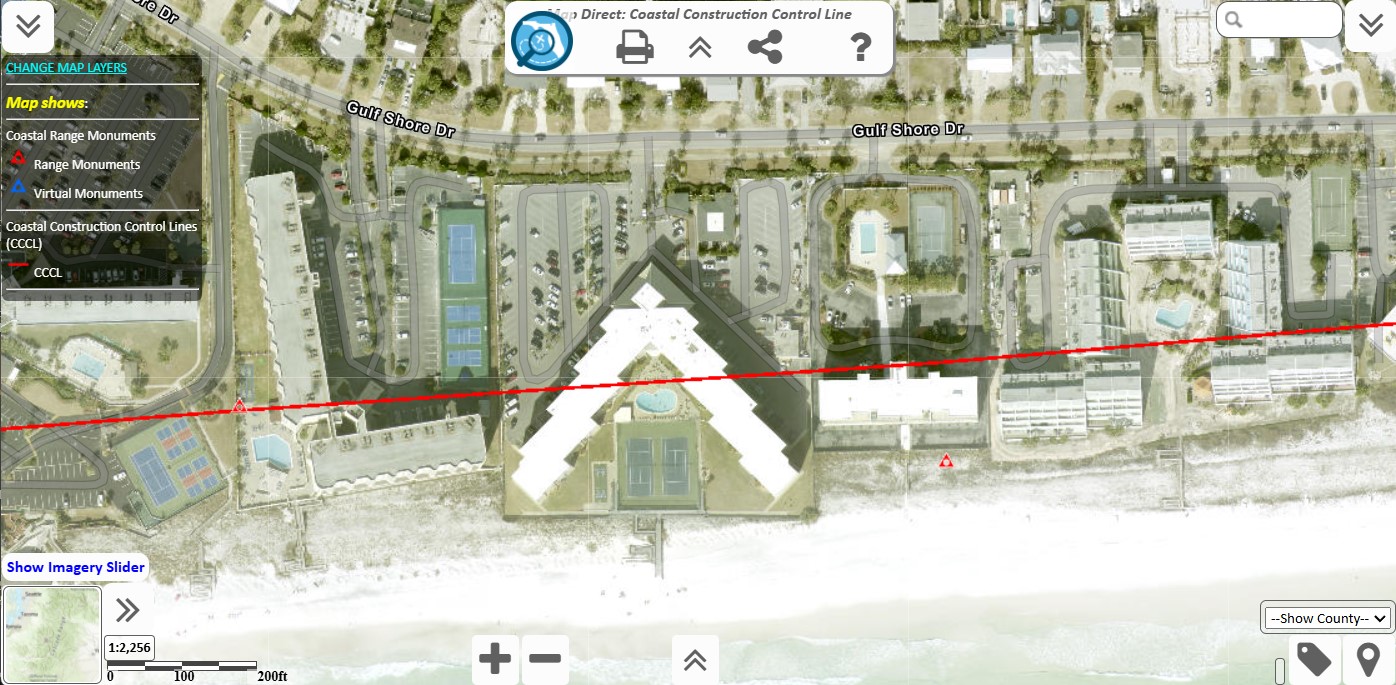
Article Highlight: The Coastal Construction Control Line (CCCL) is a regulatory boundary enforced by the Florida Department of Environmental Protection (FDEP) to protect Florida’s native coastal ecosystems while allowing for safe, responsible coastal development.
Main Takeaway: All projects seaward of the CCCL are subject to increased regulations and permitting requirements, impacting everything from landscaping to building alterations and the care of native vegetation.
Application: Do you know where the CCCL intersects your property? If not, contact Dune Doctors to obtain an aerial map showing the CCCL’s location on your property. Before performing any work seaward of the CCCL—or hiring a contractor to do so—ensure that you have applied for all necessary permits. Dune Doctors can help you obtain the permits.
What is the CCCL and Why is it Important?
Florida’s coastline is one of the state’s most dynamic environments. Beaches constantly shift in shape and width under the influence of waves, tides, storms, and wind, yet coastal development continues to expand. Given these ever-changing conditions, it is reasonable to wonder how homes and other structures can be built and maintained so close to the surf.
One of the key tools that makes this possible is the Coastal Construction Control Line (CCCL), a regulatory boundary established by the Florida Department of Environmental Protection to promote sustainable coastal development. The CCCL balances responsible development with the preservation of the beaches, dunes, and other coastal systems that help protect waterfront communities from destructive wave action and flooding.
Importantly, the CCCL does not prohibit construction seaward of the line. Instead, it marks an area where development is subject to heightened regulatory standards. Work past the CCCL requires approvals or permits from county, state, and, in some cases, federal agencies, depending on the nature and scope of the proposed work. Because these requirements can be complex, an understanding of the CCCL is essential for coastal property owners seeking to protect their investment while remaining in compliance with Florida law.
What Does Florida’s Government Consider When Issuing a Permit?
At the state level, permit decisions are governed by Chapter 62B-33 of the Florida Administrative Code, and they involve careful review of multiple environmental and structural factors. Specifically, the FDEP assesses:
- Impacts on the beach and dune system
- Effects on adjacent properties
- Preservation of native vegetation
- Protection of wildlife habitat
- Maintenance of public access to the beach
In our experience, most permit applications are approved, but often with design modifications to ensure the project complies with environmental and construction performance standards.
What Kind of Coastal Maintenance, Construction, and Landscaping Work Requires a Permit in Florida?
After reviewing the legislation, our team has devised an easy three-part test to determine if a permit may be required.
- Does it impact the grade of the sand? Grade refers to the sand’s surface. Example: installing sand fences or laying a concrete slab to install new air conditioning units. You need a permit for both.
- Does it impact native vegetation? If you plan to remove or prune native vegetation, you absolutely need a permit. No questions asked.
- Are you enlarging an existing, permitted structure? Extending a boardwalk? Installing a retention wall alongside your pool? Paving a new section of your parking lot? You need a permit.
What about day-to-day Property Management? Do You Always Need a Permit?
Not necessarily. A permit may not be required for the following:
Routine maintenance of landscaping and non-native plants located at least 30 feet landward of the dune. Minor modifications, routine maintenance, or repairs to existing structures that remain within the limits of the existing foundation. Maintenance or repair of paved surfaces and pool structures located at least 30 feet landward of the dune, provided they do not discharge or drain onto the beach. Removal of wind-blown sand from paved roads, parking areas, and swimming pools.
Real World Example: What Happens When You Violate the CCCL?
The Madeira on Marco Island Condominium Association hired RR Restoration to repair its storm-damaged roof following a major weather event. However, what began as a common roofing project quickly escalated into environmental degradation.
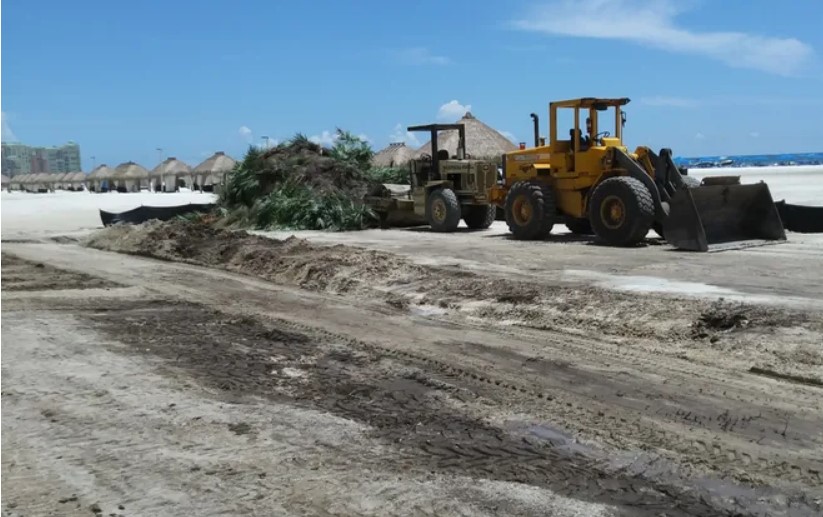
The image above shows the equipment used to level the dune feature and remove the vegetation in front of the Madeira on Marco Island Condominium Association. Image Source: City of Marco Island News
Before construction began, the contractor failed to obtain the required FDEP permits to park heavy equipment on the beachfront. As part of the work, crews excavated portions of the frontal dune, constructed a temporary equipment access path using shell material, and removed native dune vegetation without authorization. FDEP initially responded by issuing a reprimand and relatively modest fines, but Madeira had a history of violations. In previous months, Madeira was complicit in two other cases of environmental damage, prompting local officials to collaborate with the FDEP in hopes of pursuing stronger enforcement measures after determining that Madeira appeared to be a repeat offender.
What is the Cost of Violating the CCCL Program? Depends on the Damage
The investigation ultimately resulted in FDEP ordering Madeira and RR Restoration to pay a combined $15,500 in fines for damaging protected coastal dunes and removing native vegetation without the required permits. Madeira was ordered to pay $8,000, while RR Restoration was assessed a $7,500 penalty.
The financial penalties, however, represented a small fraction of the total cost. The condominium association was required to restore the damaged dune system within 180 days. The restoration plan required the placement of 1,500 cubic yards of beach-compatible sand and the installation of 1,748 native dune plants to stabilize the restored area. The project also carried strict performance standards, requiring at least an 80% plant survival rate after one year. FDEP further warned that failure to meet the restoration deadlines could result in additional penalties of $250 per day, with potential civil fines reaching as much as $10,000 per day with any delays.
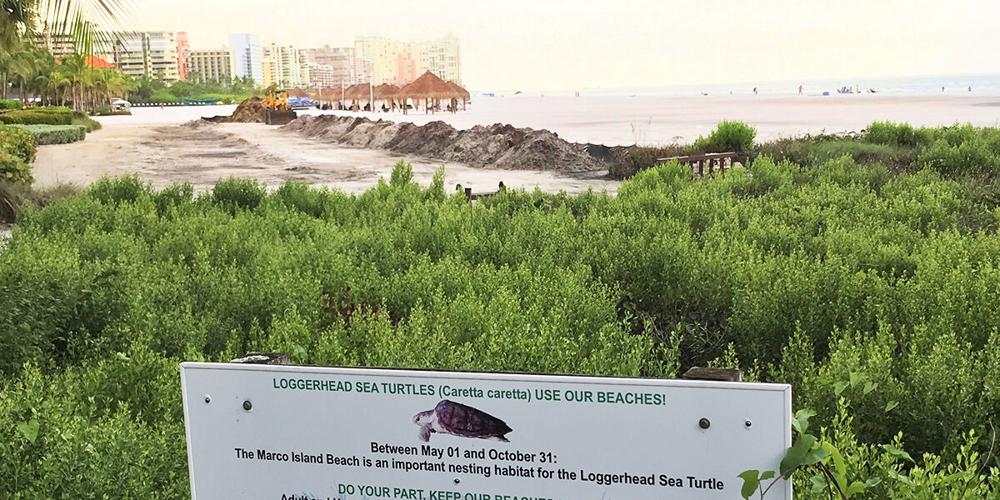
The image above shows how much dune and vegetation were excavated in comparison to the neighboring property. Photo by Maria Lamb for Coastal Breeze News
Based on Dune Doctors’ experience with projects of similar scope, we estimate that the required dune restoration cost for Madeira was likely between $300,000 and $500,000, as beach-compatible sand is difficult to source. This case helps magnify how overlooking the CCCL’s permitting requirements can expose both property owners and contractors to substantial financial liability, loss of reputation with regulatory agencies, and costly restoration projects. In response to the FDEP’s intervention, Madeira has implemented a policy requiring its management to verify that contractors obtain all necessary permits before beginning future projects.
How Effective is the CCCL Regulation?
While regulations do not always achieve their intended objectives, the CCCL program has demonstrated its effectiveness. The program was implemented on June 28, 1989, under the Florida Beach and Shore Preservation Act (Chapter 161, Florida Statutes), and its success became evident just six years later when Hurricane Opal struck the Florida Panhandle in 1995. Hurricane Opal caused catastrophic damage to coastal communities, affecting 1,992 major habitable structures built prior to the CCCL and destroying 768 of them, or a whopping 40%. However, by then, 576 homes had been constructed in compliance with CCCL standards. Of these homes, only two were destroyed, or simply 3%. Through its effective implementation of safety standards and the FDEP’s willingness to collaborate with property owners, the CCCL serves as a critical pillar of Florida’s coastal communities.
How Can You Stay Out of Trouble with the FDEP?
As part of our continuing education program about the CCCL, Dune Doctors shares four critical steps to stay out of trouble. We have set these standards as a way of vetting coastal contractors that work on your property.
- Can they identify where the CCCL intersects your property?
- Do they know the local, state, and federal regulations impacting the project?
- Do they have a working relationship with regulating authorities?
- Can they provide you with a copy of their permits?
While no project can be completely risk-free, involving the FDEP early in the planning process is one of the most effective ways to avoid costly issues later. If you have any questions about your proposed work or are unsure whether permits are required, contact the FDEP before moving forward. If you’re having trouble reaching the appropriate staff or navigating the process, don’t hesitate to reach out to us! We’re happy to help facilitate communication and guide you in the right direction.