• Skip to primary navigation
  • Skip to main content
  • Skip to primary sidebar
dune-doctors-logo
Search
Let’s Talk 866-386-3737
  • Get Started
    • Dune Diagnostic Form
  • Our Expertise
  • Our Services
  • About
    • Our Team
    • Our Clients and Coastal Partners
    • 25 Years History Timeline
  • Resources
    • Prescription for Protection
    • Articles
    • Videos
    • Regulatory Agencies
    • Science and Reports
  • Contact
  • Prescription for Protection
  • Get Started
    • Dune Diagnostic Form
  • Our Expertise
  • Our Services
  • About
    • Our Team
    • Our Clients and Coastal Partners
    • History Timeline
  • Resources
    • Prescription for Protection
    • Articles
    • Videos
    • Regulatory Agencies
    • Science and Reports
  • Contact
  • Prescription for Protection
  • Let’s Talk 866-386-3737
  • Our Expertise
  • Our Services
  • About
    • Our Clients and Coastal Partners
    • Our Team
    • Contact Us
  • Resources
    • Videos
    • Science and Reports
    • Articles
    • Prescription for Protection
  • ASBPA

Frederique Beroset MBA & M.S. in Biology

6 Symptoms of an At-risk Dune Ecosystem

November 18, 2019 by Frederique Beroset MBA & M.S. in Biology

Robust Dunes Protect Thriving Coastal Economies

            In the past decade, tourism has increased by 67% in the state of Alabama. The state’s tourism department report for 2018 proudly highlighted that travelers spent over 15.5 billion an 8.5% increase from the previous year. The most visited location in Alabama was Baldwin county and it’s beautiful quartz crystal beaches. With a thriving economy in place, Baldwin is striving to protect its coastal community from natural threats. Baldwin county has taken upon itself to define what resilience means for their community as the federal definition does not yet reflect the era of super-storms we have just entered. As homeowners collaborate with insurance providers, engineers, and policymakers, the state of Alabama is now leading the country in constructing storm-resilient homes. 

         Constructing and adapting homes to withstand the impacts of powerful storms is fundamental to the sustainability of coastal economies. However, without a robust dune ecosystem to absorb the shock of storm surge, the buildings closest to the water, unfortunately, become the first line of defense against high-speed winds and devastating surge. 

6 Symptoms of an At-risk Dune Ecosystem

         Strengthening the dune ecosystem that lines your property is the most cost-effective way to build a buffer that can minimize the reach of storm surge. Naturally-occurring sand dunes are irregular piles of sand both easily eroded and relocated by storms. However, with routine maintenance and development, you can transform this nomadic structure into a continuous berm that can offer you the protection you need. 

        Chances are you already have some type of dune formation on the beach-front side of your coastal property. However, a question we often receive from clients is, “are my dunes the best they can be?” Many factors can affect your dune’s health and to help you recognize whether there is an issue, here are 6 symptoms of an at-risk dune ecosystem. 

1. There are foot pathways that cut through the dunes 

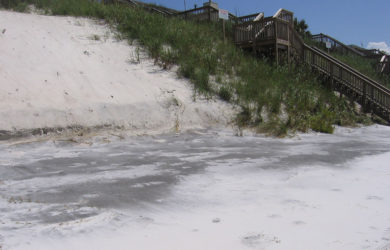
          How do you access the beach? If you walk through the dunes, overtime, a pathway will form. Similar to how you can increase the water pressure of a hose by covering part of the opening with your thumb, the foot pathway will channel all the destructive energy of the storm surge directly towards the properties on the other end of the trail. This phenomenon is called the funnel-effect. Another issue that arises is blow-out potential. Blow-out zones are depressions in a sand dune and are commonly caused by foot traffic. Storm surge plowing through the walkway will also greatly erode or “blow-out” the dune area surrounding the depression. This effect leaves behind a gaping hole in your berm. 

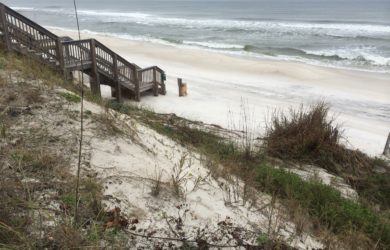
2. The boardwalks are not built to accommodate sand dune growth

          When developing your protection, the goal is to strengthen and widen your main dunes with native vegetation and build new lines of defense. The idea is to install sand fences seaward of your main dune.  The sand fences help mother nature progressively accrete sand to form a new berm. In case of a storm, you would rather lose a portion of the new berm and not have the main one impacted. A boardwalk’s length needs to reflect this long-term vision of dune growth. To read more click here!

3. There is an irrigation system on the sand dunes 

           Native vegetation helps anchor your sand dunes with deep web-like roots that act as a net to hold sand in place. The plants grow these deep roots to seek out water. However, if you provide water along the surface of the dunes, the plants’ roots will have no incentive to go deep. By remaining shallow, the roots cannot protect against erosion. Shut off all irrigation systems to begin reversing these effects. To read more click here!

4. There is an accumulation of dead plant material around the vegetation 

          Thatch is dead organic plant material that accumulates at the base of the plants. Dune vegetation relies on storms and wind to rapidly bury this dead organic material for the plant to feed off the nutrients. However, due to coastal development and weather patterns, environmental factors may have caused thatch to build-up on some sand dunes. Dried out thatch is a fire hazard, and wet thatch acts like mulch and is a nesting bed for diseases that can kill your healthy plants. Thatch weakens your vegetation, so only use professional help to remove it without uprooting your plants. To read more click here!

5. Invasive species are crowding out the sand dunes 

          The coast has many ports of entry by which exotic vegetation has entered our communities. Invasive plants that alter the ecology of, hybridize with or crowd out native plants are considered invasive. The beach vitex and naupaka flower are two plants that have displaced native vegetation along the Gulf Coast. Both species can easily reproduce both by seed or cuttings, so do not attempt to weed whack either. Have a professional team remove the invasives to minimize accidental spreading. To read more click here!

6. The sand dunes are regularly fertilized 

         Dune vegetation has it hard enough, and fertilizing the sand may seem like a way to give the plants a leg up on their environment. However, Gulf Coast beaches are mostly comprised of quartz crystal, and standard fertilizer cannot stick to the particles as it does with garden soil. The few nutrients the plants manage to get ahold of can cause the vegetation to look healthy and robust, but a closer look at the roots will tell a different story. By concentrating nutrients along the surface, fertilizer dissuades the plants from growing deep roots in search of food and water. We have perfected a slow-release formula that will ensure root growth without compromising the plant’s health. To read more click here! 


          With these 6 symptoms in mind, reflect on the dunes that line your property. Do any of these points ring a bell? If so, fill out our Dune Diagnostic Form, and let us diagnose these potential vulnerabilities for you. Simply check the box for each image that matches what you see around your dunes, and we will shortly contact you and visit your property. We deeply care about strengthening the coast and will provide you with a Dune Master Plan™️ presentation free of charge and tailored to the needs of your sand dunes. 

References and Helpful Sources 

Alabama’s Tourism Report for 2018

Alabama leads the nation in building the strongest hurricane-resilient homes. 

Florida Department of Environmental Services: Building Back the Sand Dunes 
Filed Under: Maintenance, Prescription-January Tagged With: coastal restoration, hurricane resilience, invasive plant species, sand dunes

Hurricane Michael, a Glance Back and a Glimpse Forward

July 17, 2019 by Frederique Beroset MBA & M.S. in Biology

Ten Months after the Storm

Nearly a year has passed since Hurricane Michael ravaged northern Florida, but the impact of the storm is still visible and being felt across the panhandle. National and local efforts are in place to reconstruct the affected beaches and to help the communities rebuild. Prior to Hurricane Michael, a significant portion of the area was already considered critically eroded. These eroded sections of dune stood no chance against Michael’s powerful storm surge. The damage from this storm expedited renourishment projects that were already underway, and long-term efforts were introduced to protect against further erosion.

Michael’s Path of Destruction

Hurricane Michael was the biggest storm in recorded history to make landfall along the panhandle. At first, the hurricane was categorized as a category 4 hurricane. However, in April of 2019, the National Oceanic and Atmospheric Administration (NOAA) conducted a detailed post-storm analysis and determined the storm was actually a category 5 hurricane. The analysis confirmed that the storm produced sustained winds of 160 mph.

The primary areas affected were the beaches in and around Bay County, stretching from Panama City Beach to Mexico Beach. According to Michael Dombrowski (Principal and Coastal Engineer with MRD Associates, Inc.), most of Mexico Beach was completely obliterated. He also reports that sections of St. Andrews State Park remain closed because the surge from Hurricane Michael flattened 30-foot high dunes all along the park’s coast. Tourist Development Council beach consultant to Bay County, Lisa Armbruster, reports similar sand dune loss on the Panama City beach.

Coastal Erosion Is a Big Issue

According to Lisa Armbruster, an estimated 600,000 cubic yards of sand was lost over a span of 18.5 miles at Panama City Beach where the storm surge only reached 4.5 ft. On the other hand, Armbruster said the storm brought “phenomenal” surge of 16 to 20 feet in Mexico Beach. She estimates that Mexico Beach, alone, will require 1-1.5 million cubic yards of sand to rebuild the eroded beach and restore the dunes back to an adequately protective state. Even more astonishing, the erosion that Mexico Beach experienced was highly concentrated along a 3-mile span of beach. The extent of hurricane-force that slammed into Mexico Beach was unprecedented. Michael is the most powerful storm on record to make landfall in the Florida Panhandle. 

If you would like to see what areas are considered critically eroded along the Florida coastline, you may use the interactive map below to zoom in on a specific location. The red line designates areas that are critically eroded, and the blue line designates areas that are not. This map was created by the Florida Department of Environmental Protection and is based on their latest analysis of coastal erosion. 

Where Does the Sand Come From?

Unlike the sand from other beaches, which is often a blend of many different types of minerals and bits of pulverized shell, the homogenous composition of the panhandle’s sand is unique. Comprised primarily of quartz, much of Florida’s panhandle sand is renowned for its softness and sugar-white color. It is the result of thousands of years of deposition that originated from the breakdown of landmasses, such as the Appalachia mountain range, and was carried via rivers to the Gulf of Mexico.

Simply trucking in ‘generic’ sand to rebuild the destroyed coast is not an option. In order to restore the beaches to their original pristine aesthetics, only Florida sand can be considered. And, outside sources for this type of sand don’t exist.  Currently, the sand for these restoration/reclamation projects is being locally-sourced through dredging of the canal at Mexico Beach.

Restoration Efforts Underway

Restoration projects in these areas include continued debris removal, beach renourishment, boardwalk reconstruction, and the construction of the emergency berm at Mexico Beach. According to Kimberly Shoaf, president of the Mexico Beach Community Development Council, a 5-year Emergency berm has been constructed. The structure is 3.1 miles long and was built using approximately 95,000 cubic yards of sand. Multiple dune vegetation species totaling approximately 282,400 plants have been installed on the protective berm to stabilize the new structure. To widen the structure via sand accretion, 15,600 linear feet of sand fencing was placed to line the berm. Displayed below are the latest images of the completed emergency berm on Mexico beach. These images were sent to us by Kimberley Shoaf and the engineering team responsible for the project.


Further Consideration

The creation of a protective berm is the best line of defense against the destructive forces of coastal storms. Installing a boardwalk over the berm (as opposed to creating dunes with breaks for beach access) also enhances the protective effects of a berm by controlling where and how people travel.

When walkways are cut through dunes, it weakens the dune structure and can actually channel damaging stormwater directly back to your property. For this reason, it is best to place paths at the ends of berms to the sides of properties.

Engineers and public officials continue to work together to restore the beaches’ defense lines. The projects, themselves, are on schedule but the government funding may delay implementation.  According to Michael Dombrowski, federal funding is going to reimburse the counties in an estimated 5 years after the projects are completed. For this reason alone, it is important to have your own independent financial long-term plan in place. All in all, a spirit of resiliency is present along the coastline despite the underlying concern of what 2019’s hurricane season might have in store. 


Filed Under: Education, News & Events

Dethatching: Healthy Sea Oats build Resilient Shorelines

May 8, 2019 by Frederique Beroset MBA & M.S. in Biology

Along the eastern seaboard and Gulf states, sea oats help limit coastal erosion. Dune vegetation is one, if not the most crucial, part of the successful building and stabilization of dunes. Unlike other plants, they can thrive on the beach because of two properties: a robust root system with a web-like quality and the ability to continue to grow upwards despite being repeatedly covered in sand. Through this cycle of sand accretion, the plant actively expands its root system and widens the hurricane defense barrier. Sea oats are so instrumental to the sustainability of our beaches that the plants receive government protection in most states. Sea oats stabilize the dune allowing the ecosystem to thrive, and to maximize the plant’s effectiveness, routine maintenance is advisable.

Sea Oats are Critical to help limit Coastal Erosion

Sand Dune with and without vegetationThe image to left depicts a  dune  partially covered in vegetation. The section that is bare lost $5,000 to $7,000 worth of sand due to enormous erosion brought on by a storm. However, if you look closely, you can observe roots sticking out of the cliff. This growth indicates that the adjacent plants’ web-like root systems that are 15 ft away helped hold the remaining sand in place. Healthy sea oats can help you avoid tremendous loss by anchoring your protective berm in the face of coastal storms.

How Do Sea Oats Anchor the Dunes?

While there are many types of plants that protect against coastal erosion, sea oats are the most prevalent (and critical) species along the coast in America. According to a fact sheet provided by the USDA, mature sea oats’ leaves reach about 24 inches in length and their flowers reach about 6 feet in height. At the base of the plant, there are special stems that have bulges or nodes. These bulges will “root down and anchor to the soil surface” as the wind carries sand over the plant. Sea oats also produce rhizomes that are, in part, responsible for the plants’ expansion and colonization of the dunes. Those rhizomes also help strengthen the thick mesh-like quality of the plants’ complex root system. Sand accretion stimulates the plants to grow sideways by pinning down these stems and encouraging new root systems to grow from its nodes. The sand burial cycle is critical because it encourages the plants to fight for their survival by pushing through the particles of sand with their new stems widening the plants’ grip on the sand dune. Most importantly, it buries any dead organic material from the plants and allows it to decompose, under the sand, into nutrition that seeps down to the roots.

What is Thatch?

Sea oats are sometimes susceptible to the accumulation of thatch (dead plant material) around the base of the plant. This buildup proves detrimental to the plant’s health and jeopardizes the role the plant plays in the dune’s ecosystem. Thatch is a form of mulch. Mulch can be comprised of many substances–dried plant material, wood chips/bark, coconut husks, gravel, even shredded rubber. The function of mulch is to keep moisture in the ground. On the dunes, thatch is composed of the plants’ dead/spent leaves and stems that remained above the sand. This buildup forms a mass of dead plant material that mats together in a clump resembling a ball of yarn at the base of the plant. One might assume thatch would be beneficial to the plants (by providing nutrients and moisture retention) and should therefore not be removed. However, if thatch accumulates faster than sand accretion can bury it the sea oats can reach a plateau in their growth.

How does Thatch Adversely Affect Dune Vegetation?

Sea oats stabilize the dune they grow on by sending out deep roots in search of water. But, in order to do so, the plants need nutrients that can support this endeavor.  A buildup of thatch creates multiple problems: it encourages shallow roots, does not decompose into nutrition for the plant, and can harbor diseases and pests. This clump of rotting organic material concentrates moisture at the surface of the soil. With access to a shallow water source, the plants no longer need to send out deep roots and offer no protection to the dune. When left unburied, thatch cannot decompose to become the nutrients the plants need to grow throughout the dune. Thatch creates an environment favorable for diseases to proliferate, often proving fatal to the plant. Furthermore, the buildup provides a place for non-native rats and snakes to lay claim to the dunes. If you are noticing an increase in snakes around your property, check out our comprehensive guide on how to address this issue.

Sea Oats on the Dunes’ Slope Are Most at Risk

When observing a constructed dune, typically, the sea oats at the base of the dune are the tallest and strongest. The plants on the dune’s slope tend to be shorter and less robust by comparison. The main difference between the two plants is that the sea oats at the foot of the slope undergo the process of cyclical sand accretion while the plants on the slope remain unburied. Thatch begins to accumulate at the base of the plants on the slope as their spent leaves and stems remain above the surface of the sand. The presence of high moisture at the sand’s surface (from this thatch/mulch), in turn, causes the plants to develop shallow root systems and stunted growth. These plants become weak and very easy to uproot. The sea oats growing on the incline of the slope are critical to holding the formation in place just as the ones present at the base of the slope are critical to expanding the dune. Since those plants do not go through the cycle of getting buried, they are the ones that most need maintenance.

Dry Thatch Poses a Fire Hazard

In a long period of drought (when rain does not wet the accumulated thatch), the thatch dries out, making it extremely flammable. This dry thatch poses a significant fire hazard that a cigarette butt, 4th of July fireworks, or other accidental sparks can easily ignite. According to Panama City News Herald, in 2018, roughly 1.5 acres of federally protected land by the Destin bridge caught on fire due to illegal firework activity. The fire spread quickly as various emergency response teams attempted to stop it. Properties that do not regularly dethatch may be at an increased risk of undergoing a similar fate.

Academic Efforts to Protect Sea Oats

With the ability to thrive in saline environments with high temperatures, droughts, and temporary inundations, sea oats help defend the shoreline against erosion. For the Alabama and North West Florida Coast the 2004 & 2005 hurricane seasons were a wake-up call in that the storms damaged or destroyed much of the natural sea oats population that serve as seed sources to generate new plants. Because of how critical the plant is to dune preservation, Michael Kane an environmental horticulture professor for the University of Florida, spearheaded a project to cryogenically freeze thousands of sea oat samples from all major sea oat populations along Florida’s coast. In addition to this particular sea oats library, other universities ensure that genetic variety is kept with banking seeds from different areas. The importance of this plant for dune preservation cannot be overstated and should be protected for future generations.

Leave the Maintenance to Professionals

We have discussed the importance of removing thatch, but not everyone is qualified to remove it. Since very few plants can grow as their bases are covered, sea oats are accustomed to anchoring themselves with “dense root webs.” When thatch accumulates, sea oats are in a weakened state and are more likely to be accidentally pulled from the soil. Therefore, it is highly recommended that only a team of qualified professionals, who have a working understanding of the plant’s nature, be the ones to remove the accumulated thatch. Sea oats are vital to successful dune preservation. It is our job as Coastal Stewards to protect and nurture them to the best of our ability. If your dune vegetation is undergoing the cycle of sand accretion, then mother nature handles the dead organic material. However, if you are in a situation where your plants are not undergoing natural sand accumulation, you should get professional help.

Sources:

“Freezing Sea Oats.” Florida Sea Grant, 27 Sept. 2017, www.flseagrant.org/news/2012/09/sea-oats/. ,

Osbourne, Heather. “Fire Chief: Fireworks Likely Started Destin Fire.” Panama City News Herald, Panama City News Herald, 6 July 2018, www.newsherald.com/news/20180706/fire-chief-fireworks-likely-started-destin-fire.

R. Alan Shadow. Plant Fact Sheet SEA OATS. Plant Fact Sheet SEA OATS, plants.usda.gov/factsheet/pdf/fs_unpa.pdf.

Filed Under: Maintenance

The Do’s and Don’ts of Fertilization on Sand Dunes

May 8, 2019 by Frederique Beroset MBA & M.S. in Biology

From blue whales to microscopic organisms, every living thing on earth must eat to survive. Coastal plants are no exception! It is common knowledge that plants first need air, water, and sunlight. But, for sea oats to access the water deep within the dunes, they need a deep root system. Strong root system development requires an adequate nutrient source. Sand is generally a nutrient-poor soil. Whether the sand can naturally provide vital nutrients to the vegetation depends partly on the sand’s composition, which varies by location. Sometimes, to encourage the development of healthy dune vegetation, special fertilizer needs to be applied to the soil.

How Does Sand Composition Vary Along the Gulf Coast?

From a nutrient standpoint, Texas’ beaches boast ideal sand composition because two sources readily provide new sediment and nutrients to its coastline: the Mississippi River and in-state rivers. The World Ocean Review, an international publication of oceanographic science reports, states that the Mississippi River empties vast amounts of sediments and nutrients into the Gulf of Mexico and wind carries the content westward along the shoreline. In addition to the silt from the Mississippi, according to the American Geological Society, Texas has different primary in-state rivers that deliver a “distinct suite of heavy minerals” to the coast. These diverse sediment sources are what make Texas sand a very rich soil with nutrients easily accessed by the coastal plants’ roots.

At the direct opposite end of the nutrient spectrum are the beaches located to the east of the Mississippi. The sand along the eastern shoreline of the Gulf Coast is known throughout the world for its aesthetic qualities white, soft, and pristine. This “sugar-white” sand is primarily composed of quartz crystal a mineral resistant to chemical and physical weathering. However, the University of Florida states that, unlike Texan sand, the quartz particles present on the shoreline do not “hold water or nutrients very well.” Nutrients cannot chelate to the smooth quartz particles. Texas beaches do not require fertilization, but beaches mainly comprised of quartz do. The fertilizer, however, needs to be specifically tailored to the needs of the plants that grow on the dunes and designed to function with quartz sand.

Where Does White Sand Come From?

quartz-crystal

The generally-accepted theory is that the quartz, located on the gulf coast, arrived there through extensive erosion of the rock formations from the Appalachian Mountains. Rivers carried inland sediments into the Atlantic Ocean and the Gulf of Mexico. However, over time, the large rivers shifted, cutting off the supply of new sand to a large section of the Gulf Coast. The continual churning motion of the tide and chemical reactions in the water eroded all of the weaker minerals and only crystal quartz remained on these beaches. In an interview in 2017, Stephen Leatherman a geologist and coastal scientist, explained that Florida’s beaches reached an “ecological equilibrium” when the quartz weathered down to its “terminal size” and became “trapped by the action of the waves.” The crystal quartz gives the sand a white color and sugar-like consistency. In combination with the sunlight, the sand reflects through the water giving waves the beautiful emerald color for which the quartz-comprised beaches are known.

How Does Beach Raking Impact Sea Oats?

Close up of seaweed rake

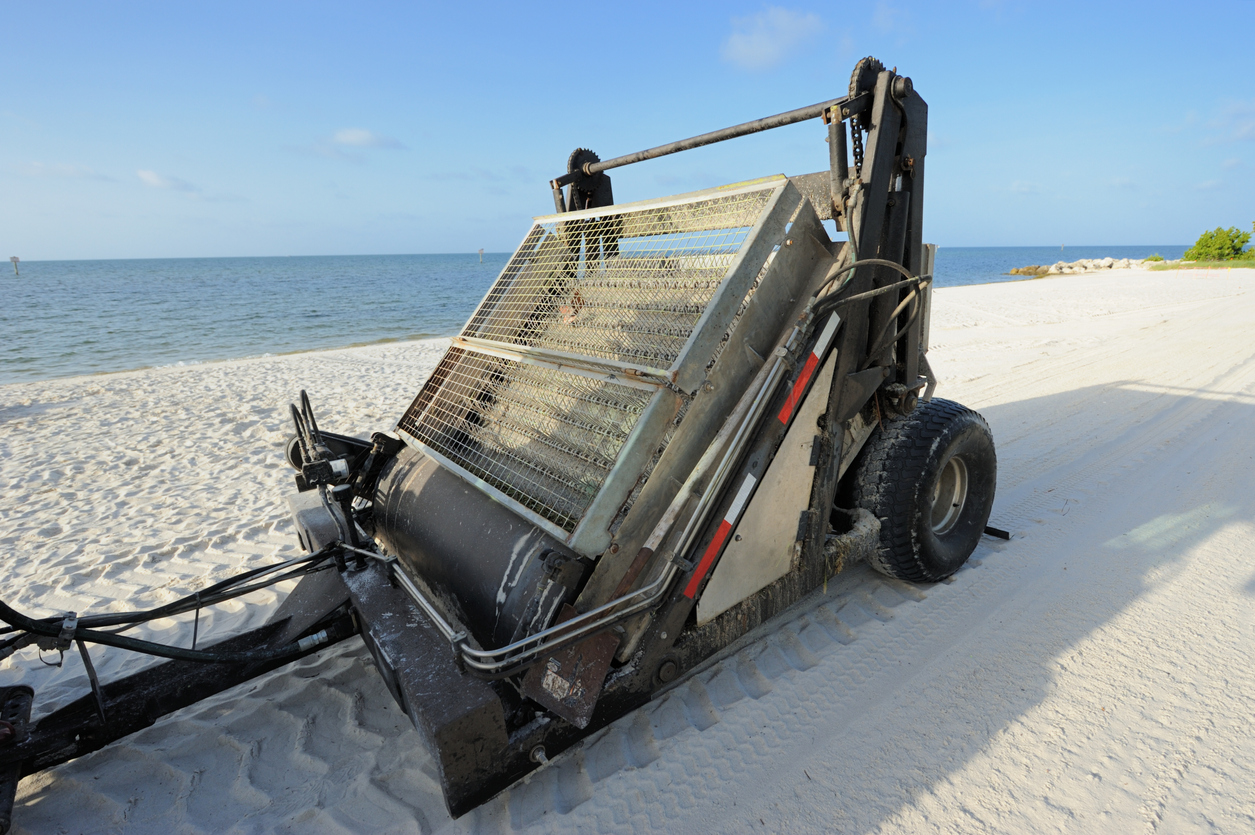
While these pristine beaches are incredibly relaxing to look at, their composition makes it difficult for plants to grow. One of Mother Nature’s methods of fertilizing coastal plants is by routinely depositing seaweed on the coast. According to a dune management guide put out by the Department of Environmental Resources Management of Palm Beach County, seaweed “creates a nutrient-rich organic layer” that feeds the animals and plants that live on the shore. However, to both prevent the unpleasant aroma of decomposing seaweed and return the beaches to their pristine condition, humans routinely remove the deposited seaweed before it has a chance to decay. This process is called beach raking and is part of why the fertilization of the sea oats becomes a vital part of maintaining healthy  dunes.

When Should You Fertilize Sea Oats?

When growing in nutrient-poor conditions, two other situations contribute to the sea oats’ need for fertilization—the initial planting and the process of dethatching. Both circumstances are stressful to sea oats as both instances see plants with shallow root systems. Dethatching is the process by which thatch is removed from the base of the plants. Thatch is an accumulation of dead/spent organic material, which is detrimental to sea oats because it holds moisture at the surface of the sand. This causes the plant to develop a shallow root system that will not adequately anchor the plant to the dune. It may also cause the plant to rot as the thatch layer encourages an environment prone to disease development.

Once the thatch is removed, water availability is no longer shallow, and the plant’s root system needs to be encouraged to grow deeper in the soil in search of a new water source. Slow-release fertilizer provides the nutrients necessary for the plant to develop a strong network of webbed roots to find water and to anchor the dunes in place. This specific fertilizer helps the plant achieve this growth by delivering small amounts of nutrients in the soil over time. A publication on dune restoration by North Carolina State University warns against excess fertilization, stating that it may “damage the development” of the plants and “increase the occurrence of plant diseases.” The fertilizer will be best absorbed during the growing season. We recommend one application of fertilizer in late Spring and one in late summer/early fall. Because of their deep, web-like root system, sea oats are of paramount importance in the building and maintaining of sand dunes. For this reason, sea oats are federally protected due to their integral role in dune preservation.

What Kind of Fertilizer Do Sea Oats Need?

Fertilizers, as a plant growth enhancer, vary in purpose. They are formulated to focus on one (or more) of four distinct functions within plants. Certain formulas strengthen the roots or create denser foliage, while others encourage flower production and fruit yield. When the goal is to strengthen a dune system, the primary purpose of the fertilizer should be to help the plants develop strong, deep roots. The fertilizer applied should be slow releasing and specific for sea oats. For these reasons, applying a general fertilizer (intended for gardens) on the dunes can be extremely detrimental to the health of the fragile dune ecosystem. These all-purpose fertilizers may create the illusion of a healthy environment because the plants above the ground look thriving. Still, below the ground, the root systems are weak and debilitated. Avoid creating environmental hazards by entrusting professionals who have extensive knowledge in this domain to fertilize your dune system.

Strong root systems = Resilient Dunes.

Sources: 

Broome, Stephen. “Restoration and Management of Coastal Dune Vegetation | NC State Extension Publications.” Restoration and Management of Coastal Dune Vegetation | NC State Extension Publications, content.ces.ncsu.edu/restoration-and-management-of-coastal-dune-vegetation.

Bullard, Fred M. “Source of Beach and River Sands on Gulf Coast of Texas.” GSA Bulletin, GeoScienceWorld, 1 July 1942, pubs.geoscienceworld.org/gsa/gsabulletin/article-abstract/53/7/1021/3939/source-of-beach-and-river-sands-on-gulf-coast-of?redirectedFrom=fulltext.

Palm Beach County Board of County Commissioners. Guidelines for Beach & Dune Management. Guidelines for Beach & Dune Management, discover.pbcgov.org/erm/Publications/BeachandDuneManagement.pdf.

Ronson, Jacqueline. “The Best Sand on Earth Is This, According to Dr. Beach.” Inverse, www.inverse.com/article/32767-best-beach-sand-fine-white-quartz-crystal-siesta-florida.

“The Mississippi River and the Gulf of Mexico Dead Zone « World Ocean Review.” World Ocean Review, worldoceanreview.com/en/wor-1/pollution/over-fertilization/the-mississippi-river-and-the-gulf-of-mexico-dead-zone/.

“Working in Your Florida Soil.” Working in Your Florida Soil – Gardening Solutions – University of Florida, Institute of Food and Agricultural Sciences, gardeningsolutions.ifas.ufl.edu/care/planting/florida-soil.html.

Filed Under: Maintenance, Storm Preparation

The Dune Doctors’ New Face

March 1, 2019 by Frederique Beroset MBA & M.S. in Biology

Over the past several years, Dune Doctors LLC has steadily grown as we completed projects of varying sizes and needs along the coast. Moving forward, we plan to expand our services to areas of the USA we have previously not reached. To reflect these aspirations, we decided to transform our brand to mark the beginning of a new decade for our company. In rebranding, we are centering our identity on being leading experts in dune restoration.

The coastline is constantly changing, and Dune Doctors will evolve to match its needs. Humans and nature are often at the mercy of each other’s hand. However, when we are mindful of preserving the ecosystem around us, nature, in turn, protects us in kind.

Dune Doctors encourages people to embrace their responsibility to regard the natural coastal environment as a valuable asset that must be invested in, respected, and cared for.

“We believe when people know better, they do better.”

We are passionate experts dedicated to educating and inspiring others to be stewards for their coastal surroundings for generations to come. Using our talents, tools, and scientific background, we employ methods based on proven research. We design personalized coastal erosion and preservation solutions built for beauty and long-term resiliency.

As a dedicated team of professionals, we pride ourselves on striking the balance between our clients and the coast. Through empowered stewardship, we aim to help you Preserve, Protect, Optimize, and Maintain your dunes for years to come.

Filed Under: News & Events

How Several Seaside Communities Outsmarted Hurricane Sandy

February 28, 2019 by Frederique Beroset MBA & M.S. in Biology

Hurricanes are the worst enemy of coastal communities. Millions of dollars have been spent researching and designing ways to protect coastal properties from the devastating damage of these storms. Seawalls have been built, homes have been raised on pilings, buildings have been fortified—all in an effort to ward off the effects of hurricane-force winds and deadly storm surge. Sadly, these measures often fail. Many communities, that had invested in a wide range of defenses, suffered from extensive damage all along the Eastern seaboard when Hurricane Sandy hit in 2012.

However, several communities on the New Jersey coast emerged relatively unscathed (save damage from winds) from the impact of Sandy—among them Midway Beach, South Seaside Park, and Bradley Beach. The locals attribute surviving the storm, with minimal damage, to the sand dunes (berms) that lined their coast.

Although Hurricane Sandy eroded a good portion of these dunes, the water didn’t breach the berms and the properties landward of them were spared. For these lucky communities, rebuilding their protective dunes was priority #1 for good reason. Even though the sand dunes were the only line of defense against the raging storm, they effectively stopped the storm surge from reaching the homes and businesses.

Sand dunes, alone, cannot offer 100% protection to a coastal area during a hurricane, but there is truth in the adage, “an ounce of prevention is worth a pound of cure.” The rebuilding and maintaining of sand dunes may seem initially expensive, but the cost is a fraction compared to the billions of dollars in lost revenue for seaside businesses.

Watch the video where Bradley Beach Operating Supervisor Rich Bianchi proudly describes the results of the town’s protective berm construction: “We’re probably the only town where you can walk on the boardwalk right now.” He credits the 15 x 25 ft sand dune, built in 1996, from sparing his town a similar fate to beach communities located only a few miles away.

Filed Under: Protection

  • « Go to Previous Page
  • Page 1
  • Page 2
  • Page 3
  • Page 4
  • Page 5
  • Go to Next Page »

Primary Sidebar

CONTACT INFORMATION

WE ARE MOTHER NATURE'S MEDICAL TEAM

Toll-Free: 866-386-3737
info@DuneDoctors.com

QUICK LINKS

Get Started
Our Services
Articles
Contact Us

dune-doctors-dmp-icons

SIGN UP TO OUR ENEWSLETTER!

Join Our "On Call" Newsletter

Copyright © Dune Doctors. All rights reserved. Privacy Policy

We use cookies to analyze our website traffic and to support technical features that enhance your user experience. Read our Privacy Policy to learn more about how we use cookies.
Cookies SettingAccept
Manage consent

Privacy Overview

This website uses cookies to improve your experience while you navigate through the website. Out of these, the cookies that are categorized as necessary are stored on your browser as they are essential for the working of basic functionalities of the website. We also use third-party cookies that help us analyze and understand how you use this website. These cookies will be stored in your browser only with your consent. You also have the option to opt-out of these cookies. But opting out of some of these cookies may affect your browsing experience.
Necessary
Always Enabled
Necessary cookies are absolutely essential for the website to function properly. These cookies ensure basic functionalities and security features of the website, anonymously.
CookieDurationDescription
cookielawinfo-checkbox-analytics11 monthsThis cookie is set by GDPR Cookie Consent plugin. The cookie is used to store the user consent for the cookies in the category "Analytics".
cookielawinfo-checkbox-functional11 monthsThe cookie is set by GDPR cookie consent to record the user consent for the cookies in the category "Functional".
cookielawinfo-checkbox-necessary11 monthsThis cookie is set by GDPR Cookie Consent plugin. The cookies is used to store the user consent for the cookies in the category "Necessary".
cookielawinfo-checkbox-others11 monthsThis cookie is set by GDPR Cookie Consent plugin. The cookie is used to store the user consent for the cookies in the category "Other.
cookielawinfo-checkbox-performance11 monthsThis cookie is set by GDPR Cookie Consent plugin. The cookie is used to store the user consent for the cookies in the category "Performance".
viewed_cookie_policy11 monthsThe cookie is set by the GDPR Cookie Consent plugin and is used to store whether or not user has consented to the use of cookies. It does not store any personal data.
Functional
Functional cookies help to perform certain functionalities like sharing the content of the website on social media platforms, collect feedbacks, and other third-party features.
Performance
Performance cookies are used to understand and analyze the key performance indexes of the website which helps in delivering a better user experience for the visitors.
Analytics
Analytical cookies are used to understand how visitors interact with the website. These cookies help provide information on metrics the number of visitors, bounce rate, traffic source, etc.
Advertisement
Advertisement cookies are used to provide visitors with relevant ads and marketing campaigns. These cookies track visitors across websites and collect information to provide customized ads.
Others
Other uncategorized cookies are those that are being analyzed and have not been classified into a category as yet.
SAVE & ACCEPT